
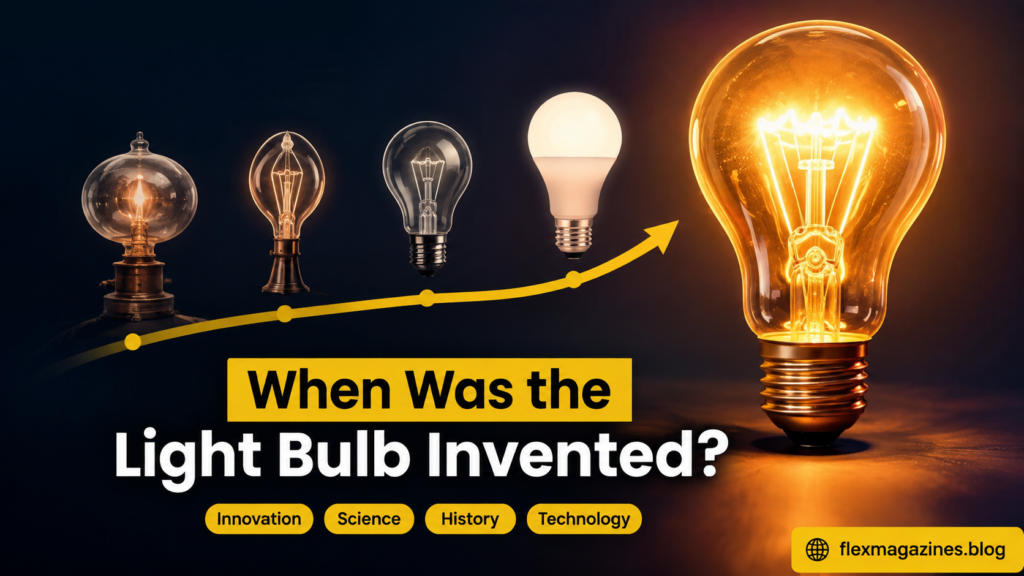

The answer to when was the light bulb invented depends on what you mean by invented.
The first experiments with electric lighting began decades before the famous Edison bulb. However, the first practical incandescent light bulb that could be used commercially was developed in the late 1870s, with Thomas Edison achieving a major breakthrough in 1879.
Many people believe Thomas Edison alone invented the light bulb, but the real history is more complicated. Several inventors contributed important ideas before Edison, including Joseph Swan, a British scientist who developed successful incandescent lamps around the same period.
Edison’s greatest achievement was not simply creating a glowing filament inside glass. His innovation was developing a reliable, long-lasting bulb and a complete electrical lighting system that could be used by ordinary people.
The invention of the light bulb transformed homes, businesses, factories, and cities. It changed how humans worked, traveled, and lived after sunset.
When Was the Light Bulb Invented?
The modern electric light bulb was developed during the 19th century, with the most important breakthrough occurring between 1878 and 1880.
A simple timeline:
| Year | Important Development |
| 1800 | Alessandro Volta demonstrated that electricity could create glowing wires |
| 1802 | Humphry Davy created one of the earliest electric lamps |
| 1840 | Warren de la Rue developed an early incandescent lamp using a platinum filament |
| 1850s–1870s | Inventors experimented with carbon filaments and vacuum bulbs |
| 1878 | Joseph Swan demonstrated an early successful incandescent lamp |
| 1879 | Thomas Edison developed a practical long-lasting incandescent bulb |
| 1880 | Edison received patents and began commercial development |
The year 1879 is commonly recognized as the year the practical light bulb was invented because Edison’s design solved many problems that prevented earlier bulbs from becoming widely useful.
Who Invented the Light Bulb?
The invention of the light bulb was not the work of a single person.
Several inventors helped create the technology, but the two names most associated with the practical incandescent bulb are:
- Thomas Edison
- Joseph Swan
Both men developed working incandescent lamps during the late 1870s.
Thomas Edison’s Role in Inventing the Light Bulb
Thomas Edison is often credited with inventing the light bulb because he created one of the first commercially successful versions.
Edison began serious research into electric lighting in 1878. His goal was to create a lamp that was:
- Long-lasting
- Affordable
- Safe for indoor use
- Easy to manufacture
- Compatible with an electrical distribution system
The biggest challenge was finding the right filament material.
A filament needed to:
- Glow brightly when heated
- Resist burning out
- Use electricity efficiently
- Work inside a vacuum
Edison and his team tested hundreds of materials before finding a successful carbon filament design.
On October 22, 1879, Edison successfully tested a carbon filament lamp that lasted for many hours. He later filed a patent application for his electric lamp design.
Edison’s work helped move electric lighting from a scientific experiment into a practical technology.
Did Thomas Edison Really Invent the Light Bulb?
The answer is more complicated than a simple yes or no.
Thomas Edison did not create the first ever electric light bulb.
Before Edison, many inventors had already experimented with electric lamps.
For example:
- Alessandro Volta demonstrated glowing wires using electricity.
- Humphry Davy created an early electric arc lamp.
- Warren de la Rue created an incandescent lamp using a platinum filament.
- Joseph Swan developed working incandescent lamps.
However, Edison improved the technology significantly.
His contribution was creating a practical system that included:
- A reliable bulb
- Electrical generators
- Wiring networks
- Switches
- Distribution systems
This allowed electric lighting to become commercially successful.
Joseph Swan’s Contribution to the Light Bulb
Joseph Swan was an English physicist and chemist who worked on electric lighting before Edison.
Swan began experimenting with carbonized paper filaments during the 1850s and continued improving his designs over several decades.
By 1878 and 1879, Swan demonstrated successful incandescent lamps in Britain.
His designs used:
- Carbon filaments
- Glass bulbs
- Vacuum technology
However, Swan’s early bulbs faced challenges similar to other inventors’ designs, including efficiency and commercial practicality.
Eventually, Edison and Swan became competitors before later joining forces through the Edison and Swan Electric Light Company in 1883.
Early Attempts Before Edison’s Light Bulb
The invention of the light bulb was the result of decades of scientific progress.
Humphry Davy’s Electric Lamp
In the early 1800s, British scientist Humphry Davy developed one of the first electric lamps.
His arc lamp produced light by creating an electrical spark between carbon rods.
Although powerful, it was not suitable for homes because it was:
- Extremely bright
- Expensive
- Difficult to operate
Warren de la Rue’s Platinum Filament Lamp
In 1840, Warren de la Rue created an early incandescent lamp using a platinum filament inside a vacuum tube.
The design worked, but platinum was too expensive for widespread use.
How Did the First Light Bulb Work?
A traditional incandescent light bulb works by passing electricity through a thin filament.
The process:
- Electricity enters the bulb through metal contacts.
- Current travels through the filament.
- The filament becomes extremely hot.
- The heated filament produces visible light.
- The glass bulb protects the filament from oxygen.
Without removing oxygen from the bulb, the filament would quickly burn away.
That is why early inventors needed strong vacuum technology.
Why Was Edison’s Light Bulb Successful?
Edison’s success came from improving several parts of the technology.
Longer Lifespan
Earlier bulbs often lasted only a short time.
Edison developed filaments that could operate much longer.
Lower Electricity Requirements
A practical bulb needed to work with affordable electrical systems.
Edison designed bulbs with higher resistance, making them more suitable for distribution networks.
Commercial Production
Edison focused on manufacturing.
He developed:
- Factories
- Electrical networks
- Power stations
- Consumer lighting systems
This helped electric lighting spread worldwide.
The First Public Demonstration of Edison’s Light Bulb
Edison publicly demonstrated his incandescent lighting system at Menlo Park, New Jersey, on December 31, 1879.
The demonstration attracted widespread attention because visitors saw electric lamps operating continuously in a practical environment.
This event helped establish Edison as one of the leading figures in electrical innovation.
How the Light Bulb Changed the World
The light bulb was more than a household invention. It changed human civilization.
Longer Working Hours
Before electric lighting, many activities depended on daylight or dangerous gas lamps.
Electric lighting allowed:
- Factories to operate longer
- Businesses to stay open later
- Cities to become more active at night
Safer Homes
Traditional lighting methods included:
- Candles
- Oil lamps
- Gas lighting
These created risks from:
- Fires
- Smoke
- Poor air quality
Electric bulbs provided a cleaner alternative.
Growth of Modern Cities
Street lighting transformed urban life.
Cities became safer and more active after dark.
Electricity became the foundation for modern infrastructure.
Evolution of Light Bulb Technology
The original incandescent bulb continued evolving.
Incandescent Bulbs
These were the traditional bulbs developed from Edison-era technology.
Advantages:
- Warm light
- Low cost
- Simple design
Disadvantages:
- Low energy efficiency
- Shorter lifespan
Fluorescent Bulbs
Fluorescent lighting became popular because it used less electricity and lasted longer.
They became common in:
- Offices
- Schools
- Commercial buildings
LED Lighting
Modern LED bulbs represent one of the biggest advances in lighting technology.
LEDs offer:
- Very low energy consumption
- Long lifespan
- Less heat production
- Multiple color options
Today, LED technology has replaced many traditional incandescent bulbs.
Interesting Facts About the Light Bulb
Edison Tested Hundreds of Materials
Edison and his team experimented with many filament materials before finding successful designs.
The First Light Bulbs Were Not Like Modern Bulbs
Early bulbs were handmade and significantly different from today’s standardized products.
The Light Bulb Was a Team Effort
Many scientists contributed to the development of electric lighting.
The final invention resulted from decades of experimentation.
Conclusion
The answer to “when was the light bulb invented” is closely connected to decades of scientific discovery.
Although electric lighting experiments existed long before Thomas Edison, the practical incandescent light bulb emerged in the late 1870s. Edison’s 1879 breakthrough helped make electric lighting commercially possible, while inventors like Joseph Swan also played important roles in developing the technology.
The light bulb changed the world by extending human activity beyond daylight hours and becoming a foundation of modern life.
From Edison’s carbon filament lamps to today’s energy-efficient LEDs, the evolution of lighting shows how innovation builds over generations.
You may also read more blogs
Best Places to Travel in December
Frequently Asked Questions About the Light Bulb
When was the light bulb invented?
The practical incandescent light bulb was developed in the late 1870s, with Thomas Edison achieving a major breakthrough in 1879.
Who invented the first light bulb?
Several inventors contributed, but Thomas Edison and Joseph Swan are most commonly associated with developing successful incandescent bulbs.
Did Edison invent the first light bulb?
Edison did not invent the first electric lamp, but he created one of the first commercially practical incandescent light bulbs.
What did people use before light bulbs?
Before electric bulbs, people used candles, oil lamps, gas lighting, and early electric arc lamps.
Why was the light bulb important?
The light bulb transformed homes, workplaces, transportation, and cities by providing reliable artificial lighting.
Who invented the LED light bulb?
LED technology was developed much later by multiple scientists and engineers during the 20th century.
How long did the first light bulbs last?
Early successful incandescent bulbs lasted significantly longer than previous attempts, but their lifespan was still much shorter than modern LED bulbs.