
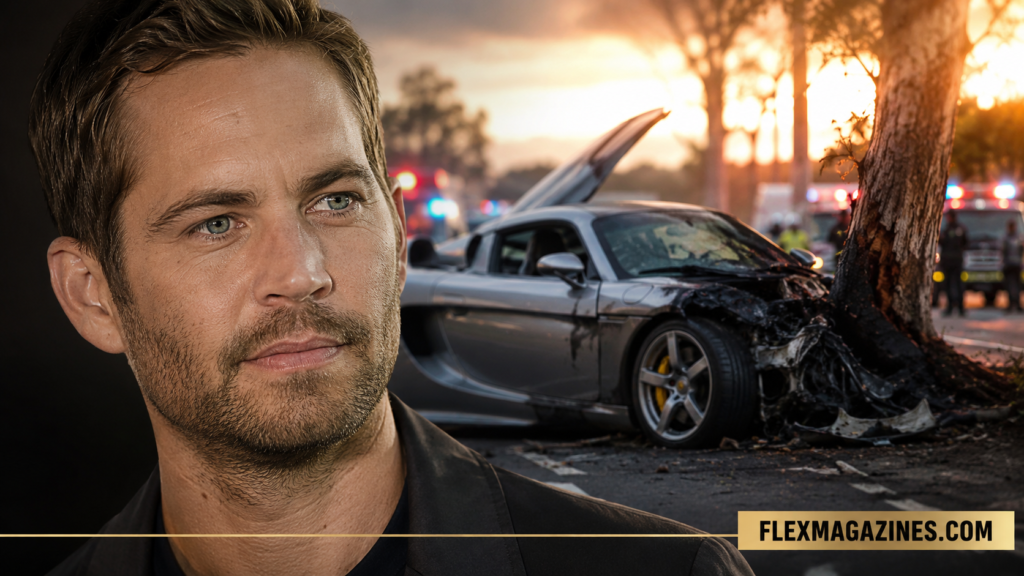

Paul Walker remains one of Hollywoods most beloved actors, remembered not only for his role as Brian OConner in the Fast & Furious franchise but also for his charitable work and humble personality. Even years after his passing, millions of people continue searching for answers to one question
How did Paul Walker die?
His sudden death shocked fans worldwide and left the entertainment industry mourning one of its brightest stars. Rumours, conspiracy theories, and misinformation have circulated online for years, making it difficult for some readers to separate fact from fiction.
This article explains exactly what happened, what investigators discovered, why the accident occurred, and how Paul Walkers legacy continues to inspire millions.
How Did Paul Walker Die?
Paul Walker died on 30 November 2013 following a devastating single vehicle crash in Santa Clarita, California.
Walker had attended a charity event benefiting victims of Typhoon Haiyan through his organisation Reach Out Worldwide. After leaving the event, he accepted a ride from his friend and professional racing enthusiast Roger Rodas, who was driving a 2005 Porsche Carrera GT.
Only minutes later, the vehicle lost control, struck several roadside objects including trees and a concrete lamp post, and burst into flames.
Both Walker and Rodas died at the scene before emergency responders could save them.
The official investigation concluded that the accident resulted from unsafe speed, not mechanical failure or street racing.
Who Was Paul Walker?
Paul Walker was born on 12 September 1973 in Glendale, California.
Although he appeared in television commercials as a child, worldwide recognition came after portraying undercover police officer Brian OConner in The Fast and the Furious (2001).
Throughout his career, Walker became known for
- Fast & Furious films
- Into the Blue
- Eight Below
- Running Scared
- Hours
Beyond acting, he was passionate about marine biology, cars, and humanitarian work. Friends frequently described him as generous, humble, and family oriented.
His genuine personality helped him build an unusually loyal fan base.
The Events Leading Up to the Fatal Crash
On the day of the accident, Walker attended a fundraising event for Reach Out Worldwide, a disaster relief charity he founded.
The gathering was held at Always Evolving Performance Motors, where car enthusiasts met to support relief efforts after Typhoon Haiyan devastated parts of the Philippines.
After spending time with friends and supporters, Walker left in Roger Rodas Porsche Carrera GT.
The drive lasted only a few minutes before tragedy struck.
Neither man expected the journey to become one of Hollywoods most heartbreaking moments.
Where Did the Crash Happen?
The crash occurred on Hercules Street near Kelly Johnson Parkway in Santa Clarita, California.
The road was part of an industrial area familiar to Rodas.
Despite clear weather and dry road conditions, the Porsche left the roadway while travelling at extremely high speed.
The impact was catastrophic.
The vehicle struck multiple fixed objects before catching fire almost instantly.
Investigators later documented extensive damage, showing just how violent the collision had been.
What Caused the Crash?
The official investigation determined that speed was the primary factor.
According to investigators, the Porsche Carrera GT was travelling between 80 and 93 mph (129–150 km/h) in an area with a 45 mph speed limit.
At that speed, the driver lost control.
The car spun sideways before hitting trees and a concrete light pole.
The force of the impact caused severe structural damage and ignited a fire.
Authorities found no evidence that another vehicle forced the Porsche off the road.
Official Investigation Findings
Several agencies investigated the crash, including the Los Angeles County Sheriffs Department and accident reconstruction experts.
Their findings concluded
- Excessive speed caused the accident.
- Alcohol and drugs were not contributing factors.
- No evidence of mechanical failure caused the crash.
- The vehicle was not involved in a street race.
- Road conditions were dry and clear.
Investigators also examined the Porsches tires, suspension, steering system, and braking components.
Although the tires were older than recommended, experts concluded that speed—not equipment failure—was the dominant cause.
The investigation helped dispel many rumours circulating online immediately after the accident.
Was Speed the Main Cause?
Yes.
Investigators consistently identified excessive speed as the main reason the Porsche became uncontrollable.
The Porsche Carrera GT was designed as an ultra high performance supercar capable of speeds well beyond ordinary road limits.
However, cars with extreme performance require exceptional skill and careful driving.
When travelling at nearly double the posted speed limit, even experienced drivers have very little room for error.
The combination of speed and the cars powerful performance characteristics proved fatal.
Did Mechanical Failure Play a Role?
Many online rumours suggested that a mechanical defect caused the crash.
Extensive forensic examinations did not support those claims.
Investigators found no evidence that
- The steering failed.
- The brakes malfunctioned.
- The suspension collapsed before impact.
Although the Porsches tyres were older and less effective than new performance tyres, investigators stated they were not the primary cause of the accident.
Speed remained the determining factor.
Was There Any Evidence of Racing?
Another persistent rumour claimed Walker and Rodas were participating in a street race.
Authorities found no evidence supporting that theory.
Security footage, witness statements, and forensic analysis did not indicate another competing vehicle caused the crash.
Investigators concluded the Porsche was travelling alone.
This finding has remained unchanged despite years of speculation across social media.
Who Was Driving the Car?
Roger Rodas was driving.
Rodas was
- A professional racing driver
- Business partner of Paul Walker
- Automotive enthusiast
- Owner of Always Evolving Performance
Walker was sitting in the passenger seat.
Both men were close friends who shared a lifelong passion for performance cars.
The Porsche Carrera GT Explained
The Porsche Carrera GT is widely regarded as one of the most demanding supercars ever built.
It features
- Mid mounted V10 engine
- Manual transmission
- Carbon fibre chassis
- Exceptional acceleration
- Lightweight construction
Many automotive experts have described the Carrera GT as unforgiving when driven aggressively.
While respected for its engineering excellence, it demands significant driver skill, especially at high speeds.
The car itself was not deemed defective in the investigation.
Injuries and Cause of Death
The crash was so severe that both occupants died almost immediately.
According to official reports
Paul Walker died from
- Combined effects of traumatic injuries
- Burns sustained during the collision
Roger Rodas suffered
- Multiple traumatic injuries
The intensity of the impact left emergency responders unable to save either occupant.
Medical examiners ruled both deaths accidental.
Public Reaction Around the World
News of Walkers death spread rapidly across social media.
Fans gathered outside crash sites, movie theatres, and memorial locations around the world.
Tributes poured in from
- Actors
- Directors
- Racing professionals
- Fans
- Charities
The emotional response reflected Walkers reputation as one of Hollywoods most respected celebrities.
Many remembered him as much for his kindness as for his acting career.
How the Fast & Furious Franchise Responded
Production on Furious 7 stopped following Walkers death.
The filmmakers faced an unprecedented challenge.
Rather than rewriting the character entirely, they chose to honour Walker by completing Brian OConners story respectfully.
His brothers, Caleb Walker and Cody Walker, helped complete remaining scenes using body doubles alongside advanced visual effects.
The result became one of the most emotional endings in blockbuster film history.
How Furious 7 Was Completed
Visual effects artists combined
- Existing footage
- CGI face replacement
- Motion capture
- Performances from Walkers brothers
The film concluded with Brian OConner retiring peacefully rather than being killed.
The final farewell scene featuring See You Again became one of cinemas most memorable tributes.
It resonated with audiences worldwide and remains an emotional moment for many fans.
Paul Walkers Family and Legacy
Walker left behind his daughter, Meadow Walker, who has continued honouring her fathers memory through charitable work and public appearances.
His family has consistently focused on preserving his positive legacy rather than dwelling solely on the tragedy.
Fans continue celebrating his life through memorial drives, charity events, and social media tributes every year.
His influence extends well beyond Hollywood.
Charity Work and Reach Out Worldwide
Paul Walker founded Reach Out Worldwide (ROWW) after witnessing the need for rapid disaster relief following the Haiti earthquake.
The organisation brings together skilled volunteers to assist communities affected by natural disasters.
Even after Walkers death, the charity continues operating in his honour.
Its ongoing humanitarian efforts reflect Walkers commitment to helping people during times of crisis.
Many fans view this charitable legacy as one of his greatest achievements.
Why Is Paul Walker Still Remembered Today?
More than a decade after his passing, Paul Walker remains one of the most searched celebrities online.
Several factors explain his enduring popularity
- The global success of the Fast & Furious films.
- His humble and approachable personality.
- His passion for cars.
- His charitable work.
- The emotional circumstances surrounding his death.
His performances continue attracting new generations of viewers through streaming platforms.
Common Myths and Conspiracy Theories
Over the years, numerous false claims have appeared online.
Some alleged
- The crash was staged.
- Another vehicle forced the Porsche off the road.
- Mechanical sabotage occurred.
- Walker survived.
None of these claims have been supported by credible evidence or official investigations.
Authorities consistently maintain that excessive speed caused the fatal accident.
Readers should rely on verified reports rather than social media rumours.
Latest Update
Paul Walkers legacy continues through his family, fans, and the Fast & Furious franchise.
His daughter, Meadow Walker, remains involved in charitable initiatives and has appeared at franchise related events celebrating her fathers contribution to cinema.
The Fast & Furious series continues to honour Walkers character, Brian OConner, through respectful references rather than replacing his role outright.
Interest in Paul Walker remains exceptionally high, with documentaries, interviews, retrospectives, and fan tributes regularly revisiting his life, career, and humanitarian work. Despite ongoing online speculation, no new official evidence has changed the findings of the original crash investigation.
Conclusion
Paul Walkers death remains one of Hollywoods most heartbreaking tragedies. Official investigations established that the fatal crash on 30 November 2013 resulted from excessive speed while he was a passenger in a Porsche Carrera GT driven by his friend Roger Rodas. Authorities found no evidence of street racing, alcohol impairment, or mechanical failure as the primary cause.Although his life was cut tragically short, Walkers legacy continues to endure through his memorable performances, his disaster relief charity Reach Out Worldwide, and the millions of fans who continue to celebrate his work and generosity. More than a decade later, his story serves as both a reminder of the risks associated with high speed driving and a testament to the lasting impact one individual can have through compassion, talent, and service.
You may also read more blogs
FAQs
How did Paul Walker die?
Paul Walker died in a single car crash on 30 November 2013 after the Porsche Carrera GT he was riding in struck trees and a concrete light pole before catching fire.
Who was driving the car?
Roger Rodas, a professional racing driver and Paul Walkers close friend, was driving the vehicle.
What caused the crash?
Investigators concluded that excessive speed was the primary cause of the accident.
Was Paul Walker driving?
No. Paul Walker was the passenger.
Did alcohol or drugs contribute to the crash?
Official investigations found no evidence that alcohol or drugs contributed to the accident.
Was the car racing another vehicle?
No. Authorities found no evidence of street racing.
What car was involved?
A 2005 Porsche Carrera GT.
What is Paul Walkers legacy?
Paul Walker is remembered for his successful acting career, humanitarian work through Reach Out Worldwide, and lasting influence on the Fast & Furious franchise.