
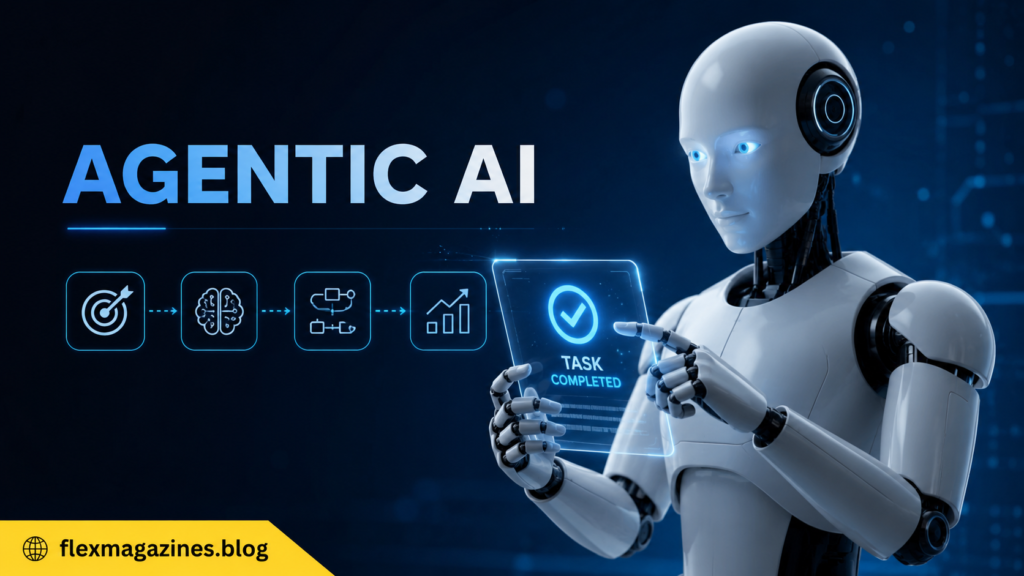

Artificial intelligence has evolved rapidly over the past few years, moving beyond simple chatbots and predictive models into systems capable of making decisions, planning tasks, and taking actions with minimal human involvement. This new generation of AI is commonly known as Agentic AI. Unlike traditional AI, which responds to prompts or performs isolated tasks, Agentic AI is designed to pursue goals, reason through problems, and interact with digital environments independently.
Businesses across industries are investing heavily in Agentic AI because it promises greater efficiency, automation, and innovation. From customer support and software development to healthcare, finance, and cybersecurity, autonomous AI agents are becoming a core part of digital transformation strategies.
This guide explains what Agentic AI is, how it works, why it is gaining popularity, its benefits, challenges, real world applications and what the future holds.
What Is Agentic AI?
Agentic AI refers to artificial intelligence systems that can independently pursue objectives by planning, reasoning, making decisions, and executing actions without requiring continuous human instructions.
Unlike traditional AI models that simply answer questions or classify data, Agentic AI behaves more like a digital assistant capable of completing entire workflows. It understands a goal, breaks it into smaller tasks, gathers information, evaluates different options, and adjusts its actions based on new information.
For example, instead of asking an AI to write a single email, an Agentic AI system could
- Read incoming emails
- Identify priority messages
- Draft responses
- Schedule meetings
- Follow up automatically
- Update CRM software
- Notify team members
All these actions happen with minimal human intervention.
How Agentic AI Works
Agentic AI combines several advanced AI technologies into one intelligent system.
The process generally follows these stages
Goal Understanding
The AI receives an objective rather than a single instruction. Instead of asking, Write an email, a user might request, Organize my client meetings for next week.
The AI identifies the final outcome before planning the required steps.
Planning
Once the objective is clear, the AI creates a sequence of tasks needed to achieve the goal.
For example
- Analyze calendars
- Find available meeting slots
- Contact participants
- Book meetings
- Send reminders
Reasoning
Agentic AI evaluates different possibilities before taking action.
If a meeting participant is unavailable, the AI searches for alternatives rather than stopping.
Tool Usage
Modern AI agents can interact with external software such as
- Databases
- Search engines
- Email platforms
- Project management software
- APIs
- Cloud services
This allows them to perform real work instead of merely generating text.
Learning and Feedback
Many Agentic AI systems improve their decision making by learning from previous outcomes, user feedback, and environmental changes.
Why Agentic AI Is Trending
Agentic AI has become one of the hottest topics in artificial intelligence because businesses are looking for automation beyond simple chatbots.
Several major technology companies have announced AI agents capable of completing complex tasks rather than only generating responses. Organizations want AI that can reduce operational costs, improve productivity, and automate repetitive workflows.
The growing popularity of large language models has also accelerated Agentic AI development. These models provide advanced reasoning capabilities, making autonomous decision making more practical than ever before.
Another reason for its popularity is the increasing demand for digital transformation. Companies are under pressure to do more with fewer resources, making autonomous AI agents an attractive investment.
Agentic AI vs Traditional AI
Traditional AI focuses on specific tasks.
Examples include
- Spam detection
- Image recognition
- Language translation
- Recommendation systems
These systems perform extremely well within their predefined roles but generally cannot make independent decisions.
Agentic AI takes a completely different approach.
Instead of waiting for individual commands, it actively plans, reasons, adapts, and completes multi step objectives.
Traditional AI answers questions.
Agentic AI solves problems.
Traditional AI reacts.
Agentic AI acts.
Key Characteristics of Agentic AI
Agentic AI possesses several defining characteristics that distinguish it from earlier AI systems.
Autonomy
It performs tasks without constant supervision.
Goal Oriented Behavior
Rather than following isolated commands, it works toward achieving broader objectives.
Planning
It creates action plans before execution.
Decision Making
The system evaluates different choices before selecting the best course of action.
Adaptability
It adjusts strategies when circumstances change.
Memory
Many AI agents remember previous interactions, allowing more personalized and efficient performance.
Collaboration
Multiple AI agents can cooperate to complete large projects more efficiently than a single agent.
Real World Applications of Agentic AI
Agentic AI is already transforming numerous industries.
Customer Service
Autonomous AI agents can manage support tickets, answer customer inquiries, escalate complex issues, and even process refunds without human intervention.
This significantly reduces response times while improving customer satisfaction.
Healthcare
Hospitals are exploring Agentic AI for appointment scheduling, patient monitoring, medical documentation, and assisting physicians with clinical decision making.
Although human oversight remains essential, AI agents can reduce administrative workloads.
Software Development
Developers increasingly use AI agents to
- Write code
- Debug applications
- Test software
- Review pull requests
- Generate documentation
These capabilities speed up software development while reducing repetitive work.
Finance
Banks and financial institutions use Agentic AI for fraud detection, investment analysis, compliance monitoring, and customer support.
Autonomous systems can quickly identify unusual transactions and respond to potential threats.
Marketing
Marketing teams use AI agents to
- Create campaigns
- Analyze customer behavior
- Optimize advertisements
- Schedule social media posts
- Generate reports
These automated workflows improve efficiency and reduce manual effort.
Cybersecurity
AI agents continuously monitor networks, detect suspicious activity, investigate threats, and initiate defensive actions much faster than human analysts.
Benefits of Agentic AI
The growing adoption of Agentic AI is driven by several important advantages.
Increased Productivity
Employees spend less time on repetitive administrative tasks and more time on strategic work.
Better Decision Making
AI agents analyze large amounts of information before making recommendations.
Continuous Operation
Unlike human workers, AI agents can operate twenty four hours a day without fatigue.
Cost Savings
Businesses can automate routine operations, reducing labor costs while maintaining high efficiency.
Faster Problem Solving
Autonomous planning enables AI systems to solve complex workflows more quickly than traditional automation.
Improved Customer Experience
Customers receive faster responses, personalized recommendations, and more consistent service.
Challenges and Risks
Despite its enormous potential, Agentic AI also introduces important challenges.
Safety
Autonomous systems must be carefully monitored to avoid harmful or unintended actions.
Poorly designed AI agents may make incorrect decisions if objectives are unclear.
Privacy
Many AI agents process sensitive business and personal data.
Organizations must implement strong security measures to protect confidential information.
Ethical Concerns
Businesses must ensure AI decisions remain transparent, fair, and free from harmful bias.
Responsible AI governance is becoming increasingly important.
Human Oversight
Even advanced AI systems require human supervision for critical decisions involving healthcare, finance, legal matters, and public safety.
Complete autonomy is not appropriate for every situation.
Industries That Will Benefit the Most
Several industries are expected to experience major transformation through Agentic AI.
Healthcare organizations can automate administrative work while supporting medical professionals.
Financial institutions can improve fraud prevention and customer service.
Manufacturing companies can optimize production planning and predictive maintenance.
Retail businesses can personalize shopping experiences and automate inventory management.
Educational institutions can create personalized learning assistants for students.
Government agencies can streamline public services and administrative processes.
Technology companies can accelerate software development and innovation.
The Future of Agentic AI
The future of Agentic AI appears extremely promising.
Experts expect autonomous AI agents to become standard business tools within the next decade.
Future systems will likely collaborate with one another, communicate across software platforms, and complete increasingly sophisticated tasks with minimal supervision.
Rather than replacing humans entirely, Agentic AI is expected to augment human capabilities by handling repetitive, data intensive work while allowing professionals to focus on creativity, strategy, and decision making.
As AI models become more capable, businesses will likely deploy specialized AI agents for sales, finance, customer service, research, programming, cybersecurity, and project management.
Government regulations and ethical standards will also continue evolving to ensure these systems remain safe, transparent, and accountable.
Conclusion
Agentic AI represents one of the most significant advancements in artificial intelligence. Unlike traditional AI systems that simply respond to commands, Agentic AI can understand goals, develop plans, make informed decisions, use digital tools, and execute complex workflows with minimal human intervention. Its ability to combine reasoning, planning, adaptability, and autonomous action makes it a powerful technology for businesses seeking greater productivity and innovation.From healthcare and finance to marketing, software development, cybersecurity, and customer service, Agentic AI is already reshaping how organizations operate. While challenges related to safety, privacy, ethics, and governance remain important, responsible implementation can unlock substantial benefits. As technology continues to mature, Agentic AI is expected to become an essential part of the modern workplace, helping people work smarter, automate repetitive tasks, and focus on higher value activities that require human creativity and expertise.
You may also read more blogs
FAQs
Is Agentic AI the same as generative AI?
No. Generative AI creates content such as text, images, or code, while Agentic AI goes further by planning, making decisions, and completing multi step tasks autonomously.
Can Agentic AI replace human workers?
Agentic AI is more likely to automate repetitive tasks than replace entire jobs. Human judgment, creativity, leadership, and ethical decision making remain essential.
Which companies are developing Agentic AI?
Many leading technology companies, AI startups, and enterprise software providers are investing in autonomous AI agents, including organizations building advanced large language models and workflow automation platforms.
Is Agentic AI safe?
It can be safe when developed with proper security, governance, and human oversight. Organizations should carefully monitor autonomous systems to minimize risks.
What skills are needed to work with Agentic AI?
Useful skills include artificial intelligence, machine learning, prompt engineering, programming, automation, data analysis, cloud computing, and workflow design.
Can small businesses use Agentic AI?
Yes. Many cloud based AI platforms now offer affordable autonomous tools that help small businesses automate customer service, marketing, scheduling, and administrative tasks.