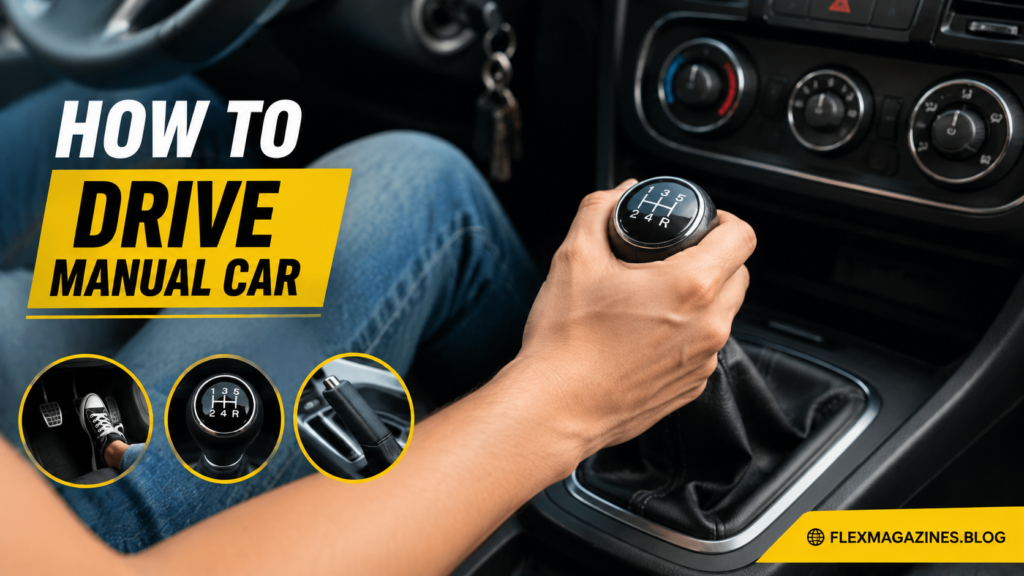

Learning how to drive a manual car can feel difficult at first because you have to coordinate your left foot, right foot, hands, engine speed, and gear selection at the same time.
The good news is that the basic process is easier once you understand what the clutch is doing.
To drive a manual car, you generally press the clutch, select the appropriate gear, gradually release the clutch while applying the accelerator, and shift gears as the vehicle gains or loses speed.
The hardest part for most beginners isnt moving the gear lever. Its learning to control the clutch engagement point smoothly.
Once you can consistently start, stop, shift, and reverse without stalling, manual driving becomes much more intuitive.
This guide explains how to drive a stick shift car from the ground up, including how to start from a stop, shift gears, downshift, drive uphill, reverse, handle traffic, and protect the clutch.
Safety note Practice only where you are legally permitted to drive and where conditions are appropriate for a learner. Follow your vehicle owners manual and local driving laws. If youre learning for the first time, professional instruction can provide a safer environment than practicing alone on public roads.
What Is a Manual Car?
A manual car, also called a stick shift car, uses a transmission in which the driver selects gears manually.
Unlike a conventional automatic transmission, a traditional manual vehicle has three pedals
- Clutch pedal
- Brake pedal
- Accelerator pedal
The driver also controls a gear shifter.
The clutch temporarily disconnects the engines power from the transmission so you can start the vehicle, change gears, or stop without stalling the engine.
The driver therefore has more direct control over gear selection.
Manual transmissions typically have several forward gears plus reverse and neutral. The exact arrangement depends on the vehicle.
In the United States, the shift pattern is normally displayed on or near the shifter. Federal Motor Vehicle Safety Standard 102 requires the manual transmission shift pattern to be displayed in the drivers view for applicable vehicles.
Understanding the Three Pedals
Before you learn how to drive a manual car, understand exactly what each pedal does.
Clutch Pedal
The clutch pedal is on the far left.
Pressing it disengages the engine from the transmission.
You use it when
- Starting the car
- Selecting a gear from a stop
- Changing gears
- Downshifting
- Coming to certain stops
- Reversing
The clutch has an important engagement point, sometimes called the friction point or bite point.
This is the point where releasing the clutch begins connecting engine power to the wheels.
Learning to feel this point is one of the most important skills in manual driving.
Brake Pedal
The brake pedal is in the middle.
Use it to slow or stop the vehicle.
Your right foot normally operates both the brake and accelerator.
Accelerator Pedal
The accelerator is on the right.
It controls engine power.
Pressing it increases engine speed, while releasing it allows the engine to slow.
Gear Shifter
The gear lever allows you to choose different transmission ratios.
A typical manual car might have
- 1st gear
- 2nd gear
- 3rd gear
- 4th gear
- 5th gear
- 6th gear
- Reverse
- Neutral
Not every manual car has six forward gears.
Always check your vehicles actual shift pattern.
How Does a Manual Transmission Work?
The easiest way to understand a manual car is to think of the transmission as a system that gives the engine different mechanical advantages.
Lower gears provide more pulling force at low speeds.
Higher gears allow the vehicle to travel faster with the engine turning relatively more slowly.
A simplified progression looks like this
| Situation | Typical Gear |
| Starting from a stop | 1st |
| Slow urban driving | 2nd |
| Moderate speed driving | 3rd |
| Faster road driving | 4th |
| Highway cruising | 5th/6th |
| Reversing | R |
These arent universal speed rules. The correct gear depends on the specific car, engine, road, load, incline, and driving conditions.
The important principle is
Use a gear appropriate for the vehicles speed and engine load.
Before You Start Driving
Dont begin practicing by immediately entering busy traffic.
First become familiar with the vehicle while it is stationary.
Adjust Your Seat
You should be able to fully press the clutch pedal without stretching your leg.
Your knees should remain slightly bent rather than locked.
You should also be able to operate the brake and accelerator comfortably.
Adjust Your Mirrors
Set your mirrors before moving.
You should have a clear view of traffic behind and beside you.
Learn the Gear Pattern
With the engine off, look at the gear pattern.
Know where
- First gear is
- Second gear is
- Third gear is
- Fourth gear is
- Fifth or sixth gear is
- Reverse is
- Neutral is
Dont guess where reverse is.
Some vehicles require you to push down the shifter, lift a collar, or perform another action before selecting reverse.
Understand the Parking Brake
Know how the parking brake works before you start.
It can be particularly useful when learning hill starts.
Practice With the Engine Off
You can practice the hand and foot movements without moving the car.
Press the clutch.
Move the shifter between gears.
Return to neutral.
Repeat.
This allows you to become familiar with the pattern without worrying about vehicle movement.
How to Drive a Manual Car Step by Step
Now lets look at the basic process.
Starting the Engine
Before starting
- Sit properly.
- Make sure the parking brake is applied.
- Confirm the gear is in neutral.
- Press the clutch pedal fully.
- Start the engine according to the vehicles instructions.
Some manual cars have a clutch start interlock.
However, dont assume every vehicle behaves identically. NHTSAs federal standards do not generally require a clutch based starter interlock for manual transmission vehicles, so vehicle specific instructions matter.
Select First Gear
With the clutch fully depressed, select first gear.
Keep your foot on the clutch.
Before moving, check your surroundings, mirrors, and blind spots as appropriate.
Release the parking brake when youre ready and when it is safe.
Find the Clutch Engagement Point
This is where manual driving really begins.
Slowly lift your left foot from the clutch.
At some point, you will feel the car begin to respond.
You may notice
- A slight change in engine sound
- A small vibration
- The front of the vehicle moving slightly
- The vehicle beginning to creep
That is the clutchs engagement point.
Dont immediately release the clutch completely.
Pause briefly at the engagement point while smoothly introducing a small amount of accelerator.
The exact pedal movement varies from car to car.
Start Moving
Once you feel the clutch begin to engage
- Gently apply the accelerator.
- Continue releasing the clutch smoothly.
- Allow the car to begin moving.
- Fully release the clutch once youre moving smoothly.
The key is coordination.
You dont want to dump the clutch suddenly.
You also dont want to hold the clutch halfway down unnecessarily.
A professional driving lesson can be especially useful for learning this physical sensation because the engagement point varies significantly between vehicles.
California DMVs driver training material describes a similar basic process find the clutchs friction point, release the brake, and smoothly coordinate clutch release with gentle accelerator input.
Why Does a Manual Car Stall?
A stall usually happens because the engine isnt producing enough power for the selected gear and the clutch is released too quickly.
For example, if youre in first gear and suddenly release the clutch without giving the engine enough time or power to connect smoothly, the engine may stop.
Beginners commonly stall because they
- Release the clutch too quickly
- Dont give enough accelerator input
- Try to start in too high a gear
- Panic when the vehicle begins moving
- Release the clutch before reaching the engagement point
Stalling is common when learning.
The goal isnt to never stall.
The goal is to understand why it happened and improve your clutch control.
How to Shift From First to Second Gear
Once youre moving in first gear, youll eventually need to shift.
A basic upshift sequence is
- Release or reduce accelerator input.
- Press the clutch fully.
- Move the shifter into the next gear.
- Smoothly release the clutch.
- Apply accelerator input again.
For example, moving from first to second
Accelerator off → clutch in → second gear → clutch out smoothly → accelerator on.
Dont focus exclusively on an exact RPM number.
Shift timing varies between cars.
Instead, pay attention to
- Vehicle speed
- Engine sound
- Engine RPM
- Road incline
- Acceleration demand
- Whether the engine feels comfortable
California DMV guidance for synchronized manual transmissions similarly describes releasing the accelerator, pressing the clutch, selecting the next gear, and coordinating clutch release with accelerator input.
How to Know When to Shift Up
There isnt one universal RPM or speed at which every manual car should shift.
A small gasoline engine, diesel engine, sports car, pickup truck, and heavily loaded vehicle can all behave differently.
Generally, you should shift up when the current gear is no longer the most appropriate gear for your speed and engine load.
You may notice
- Engine RPM becoming relatively high
- Engine noise increasing
- The car feeling comfortable in a higher gear
- The vehicle no longer needing strong acceleration in the current gear
Your owners manual may provide useful guidance.
Dont Chase Perfect RPM Numbers
Beginners sometimes become obsessed with shifting at exactly one RPM.
That can distract you from the road.
Use RPM as one input rather than the only thing you watch.
Good manual driving is about understanding the relationship between speed, engine load, gear, and clutch control.
How to Downshift
Downshifting means selecting a lower gear.
You might downshift when
- Speed decreases
- You need stronger acceleration
- Youre approaching an incline
- Youre preparing for a turn
- You want the engine to operate in a more useful range
The basic process is
- Reduce accelerator input.
- Press the clutch.
- Select the lower gear.
- Release the clutch smoothly.
- Apply accelerator as appropriate.
A lower gear generally increases engine speed at a given road speed.
That means you need to avoid selecting an unnecessarily low gear at excessive speed.
Why Downshifting Can Feel Rough
If you select a lower gear while traveling too quickly for that gear, engine RPM can rise sharply when the clutch is released.
That can produce a noticeable jerk.
Smooth downshifting requires matching the lower gear to the vehicles speed.
With experience, youll become better at anticipating the appropriate gear.
What Is Rev Matching?
Rev matching means adjusting engine RPM so that it better matches the speed required by the lower gear before fully reconnecting the drivetrain.
For a basic downshift
- Press the clutch.
- Select a lower gear.
- Briefly raise engine RPM if appropriate.
- Smoothly release the clutch.
The exact technique varies by vehicle and driving situation.
Some modern vehicles provide automatic rev matching.
Beginners dont need to master advanced rev matching before they can drive a manual car safely.
First focus on
- Smooth clutch release
- Correct gear selection
- Good road awareness
- Appropriate speed
How to Stop a Manual Car
Stopping requires coordination between braking and clutch operation.
For an ordinary stop
- Release the accelerator.
- Apply the brake smoothly.
- As the vehicle slows toward the point where the selected gear is no longer appropriate, press the clutch.
- Bring the vehicle to a complete stop.
- Select neutral if you will remain stopped for a while.
- Keep the vehicle secured with the brake or parking brake as appropriate.
You dont want the engine to fall below its comfortable operating range and stall.
Do You Always Need to Put It in Neutral at a Stop?
Not necessarily.
The correct approach depends on the length of the stop, vehicle, traffic situation, and driving practice.
If youre waiting at a long light, selecting neutral and releasing the clutch can reduce unnecessary clutch pedal holding.
If youre only slowing briefly and expect to move again, remaining in an appropriate gear may make sense.
Use good judgment and follow your vehicles instructions.
How to Reverse a Manual Car
Reverse is one of the easiest situations to overcomplicate.
First
- Come to a complete stop.
- Press the clutch fully.
- Select reverse according to the vehicles shift pattern.
- Check around the vehicle carefully.
- Release the clutch gradually.
- Use minimal accelerator input when needed.
- Move slowly.
At very low speeds, precise clutch control is more important than acceleration.
Dont reverse quickly simply because the car can do it.
Your visibility can be limited, so look carefully in all relevant directions and use mirrors and appropriate direct observation.
How to Start a Manual Car on a Hill
Hill starts are one of the most intimidating parts of manual driving.
The main challenge is preventing the vehicle from rolling backward while you transition from the brake to the accelerator and clutch.
A parking brake can help.
One common method is
- Stop with the parking brake applied.
- Press the clutch.
- Select first gear.
- Begin releasing the clutch until you find the engagement point.
- Apply appropriate accelerator input.
- Release the parking brake when the car is ready to move forward.
- Continue releasing the clutch smoothly.
The exact technique varies between vehicles.
Some modern vehicles have hill start assistance that temporarily holds the brakes.
If your vehicle has such a feature, read the owners manual to understand how it operates.
Dont Panic if You Roll Slightly
If a manual car rolls backward slightly, dont panic.
Keep control of the vehicle.
Use the brake and clutch appropriately and reset the process if necessary.
Practicing hill starts in a controlled environment is much better than learning them for the first time in heavy traffic.
How to Drive a Manual Car in Traffic
Stop and go traffic can be tiring because youre constantly operating the clutch.
Try to avoid unnecessary clutch movement.
When traffic moves
- Select the appropriate low gear.
- Maintain a safe following distance.
- Move smoothly.
- Avoid constantly riding the clutch.
- Use the brake to manage speed when appropriate.
- Select neutral during longer stationary waits when suitable.
Dont use the clutch as a substitute for the brake.
What Does Riding the Clutch Mean?
Riding the clutch means keeping your foot partially on the clutch pedal or leaving the clutch partially engaged unnecessarily.
This can cause additional clutch wear.
Examples include
- Resting your foot on the clutch pedal
- Holding the car on a hill using clutch slip
- Keeping the clutch partially engaged for too long
- Constantly slipping the clutch during slow traffic
Once the clutch is fully engaged and the vehicle is moving normally, your left foot should generally be away from the pedal.
Use the brake and accelerator normally rather than trying to control every movement through clutch slip.
How to Drive a Manual Car at Low Speed
Low speed driving is where clutch control becomes particularly important.
You might use it when
- Parking
- Reversing
- Maneuvering in a tight area
- Moving through very slow traffic
- Entering a driveway
The clutch may need controlled engagement, but dont keep it slipping unnecessarily.
At extremely low speeds, some vehicles can move with little accelerator input, while others require more.
Learn how your specific vehicle responds.
Common Manual Driving Mistakes
Releasing the Clutch Too Quickly
This is one of the most common beginner problems.
Solution slow down the clutch release and learn where the engagement point is.
Giving Too Much Gas
Excessive accelerator input can make the engine rev loudly without necessarily producing a smooth launch.
Use gentle throttle input.
Using Too Little Gas
Too little power combined with rapid clutch release can cause a stall.
Looking at the Gear Shifter Too Much
Your attention should remain primarily on the road.
Practice the shift pattern when parked so you can operate it with minimal visual attention.
Resting Your Hand on the Gear Shifter
Its better to keep both hands appropriately positioned on the steering wheel when youre not actively shifting.
Resting Your Foot on the Clutch
Avoid unnecessary pedal contact.
Choosing the Wrong Gear
If the engine sounds unhappy or the vehicle struggles, consider whether another gear is more appropriate.
Forgetting the Parking Brake
Always understand when and how to use it.
Manual Driving What Should You Practice First?
Dont try to master everything in one session.
Use a progression.
Practice 1 Pedal Familiarity
With the vehicle safely stationary, learn where the clutch, brake, and accelerator are.
Practice 2 Clutch Engagement
In an appropriate controlled area, learn where the clutch starts engaging.
Practice 3 Smooth Starts
Practice moving away from a stop without stalling.
Practice 4 First to Second Shifts
Once starts feel comfortable, practice shifting into second gear.
Practice 5 Stopping
Practice controlled stops without stalling.
Practice 6 Reversing
Practice reversing slowly and accurately.
Practice 7 Hills
Only after basic clutch control becomes comfortable should you practice hill starts.
Practice 8 Real Traffic
Progress to public road driving only when youre legally permitted, appropriately supervised if required, and comfortable controlling the vehicle.
Manual vs. Automatic Whats the Difference?
| Feature | Manual | Automatic |
| Clutch pedal | Yes | Usually no |
| Gear selection | Driver controlled | Transmission generally controls it |
| Driver workload | Higher | Lower |
| Learning curve | Steeper | Usually easier initially |
| Driver involvement | High | Lower |
| Low speed clutch control | Required | Generally automatic |
| Stalling risk | Yes | Generally no |
| Gear timing | Driver decides | Transmission decides |
Neither transmission is automatically better for every driver.
A manual can provide greater driver involvement and direct control over gear selection.
An automatic can simplify driving, especially in heavy traffic.
The right choice depends on your preferences, vehicle availability, driving environment, and needs.
How Long Does It Take to Learn Manual Driving?
There isnt a universal learning time.
Some beginners can learn basic clutch control in a few practice sessions.
Others need significantly longer.
The biggest factors include
- Previous driving experience
- Coordination
- Vehicle characteristics
- Quality of instruction
- Practice frequency
- Traffic environment
- Confidence
- Ability to recognize engine feedback
Learning to move the car is only the first step.
Being comfortable with
- Smooth starts
- Upshifts
- Downshifts
- Hill starts
- Reversing
- Traffic
- Parking
- Emergency situations
takes additional practice.
Dont compare your learning speed with another driver.
Does Driving a Manual Car Damage the Clutch?
Normal clutch use is expected.
However, poor technique can accelerate clutch wear.
Avoid
- Excessive clutch slipping
- Holding the car on a hill using the clutch
- Riding the clutch pedal
- Aggressive launches
- Repeated unnecessary clutch engagement
A clutch is a wear component, so eventually it will require maintenance or replacement.
Good technique can help reduce unnecessary wear.
Safety Tips for New Manual Drivers
Learning how to drive a manual car should never distract you from safe driving.
Keep Your Eyes on the Road
Dont stare at the gear lever.
Dont Rush Gear Changes
Smooth operation is more valuable than fast operation for a beginner.
Dont Practice in Dangerous Traffic
A quiet, legal, controlled environment is preferable for early practice.
Learn the Car Before Driving It Hard
Every manual vehicle has different
- Clutch engagement
- Pedal feel
- Gear ratios
- Engine response
- Shifter feel
A technique that feels smooth in one car may feel different in another.
Follow Local Laws
Licensing, learner requirements, supervision rules, and road regulations vary by jurisdiction.
Follow the rules that apply where youre driving.
Use Professional Instruction if Needed
A qualified instructor can correct poor clutch habits before they become automatic.
Quick Cheat Sheet Manual Driving Basics
For beginners, remember these simple sequences.
Starting
Clutch in → 1st gear → find engagement point → gentle accelerator → release clutch smoothly.
Upshifting
Accelerator off/reduce → clutch in → next gear → clutch out smoothly → accelerator on.
Downshifting
Slow appropriately → clutch in → lower gear → smooth clutch release → accelerate as appropriate.
Stopping
Release accelerator → brake → clutch in before the engine struggles → stop → neutral when appropriate.
Hill start
Brake/parking brake → clutch in → 1st gear → find engagement point → gentle accelerator → release brake → move smoothly.
The exact technique will vary by vehicle.
Conclusion
Learning how to drive a manual car is mainly about developing coordination and understanding how the clutch, accelerator, brakes, and gears work together.Start with the fundamentals.Learn the gear pattern. Understand the clutch engagement point. Practice smooth starts. Then work on first to second shifts, stopping, reversing, downshifting, and hill starts.Dont worry about becoming perfect immediately.Stalling once or several times is part of the learning process for many beginners. What matters is understanding what caused the stall and improving your clutch control.The most important rule is to practice gradually and safely.Once your feet begin to recognize the clutch engagement point and your hands can move through the gear pattern naturally, manual driving becomes much less intimidating.And remember every manual car feels different. The best general technique is combined with the specific instructions and characteristics of the vehicle youre driving.
You may also read more blogs
FAQs
How do you drive a manual car for the first time?
Start by learning the clutch engagement point in a safe, legal practice area. Select first gear with the clutch fully depressed, then gradually release the clutch while applying gentle accelerator input. Once the car moves smoothly, fully release the clutch and practice stopping and starting again.
What is the hardest part of driving a manual car?
For most beginners, clutch control is the biggest challenge. You need to learn how quickly your particular clutch engages and coordinate that movement with accelerator input without stalling or unnecessarily slipping the clutch.
How do you stop a manual car without stalling?
Release the accelerator and apply the brake. As the vehicle slows, press the clutch before engine speed becomes too low for the selected gear. Stop smoothly, then select neutral if appropriate.
What gear should you use when starting a manual car?
First gear is normally used to start moving from a complete stop. However, the correct gear can vary by vehicle and situation. Follow your owners manual and avoid starting in a gear that is too high for the vehicles speed and load.
Can you shift gears without using the clutch?
Some specialized driving techniques can change gears without conventional clutch use, but beginners should not attempt to learn manual driving this way. Use the clutch as designed and follow the manufacturers instructions.
How do you stop a manual car at a red light?
Slow down with the brake and press the clutch before the engine is forced to operate below an appropriate speed for the selected gear. If youre going to remain stopped for a longer period, selecting neutral and releasing the clutch can be appropriate.
How do you prevent a manual car from stalling?
Learn the clutch engagement point, release the clutch progressively, use appropriate accelerator input, and select a suitable gear for the vehicles speed. If the car starts to shudder or the engine speed drops sharply, press the clutch and stabilize the vehicle rather than panicking.
Is it hard to learn how to drive a stick shift?
It can feel difficult during the first few sessions because you are coordinating multiple controls simultaneously. Once clutch control and gear selection become familiar, the process usually becomes much more natural. Practice and good instruction make a significant difference.