
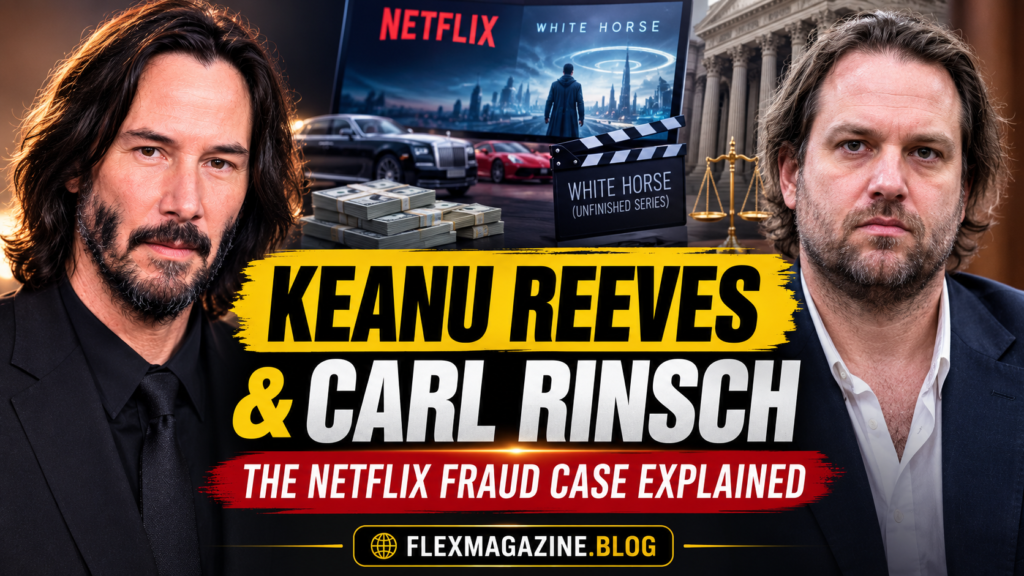

Keanu Reeves Carl Rinsch directed Keanu Reeves in the 2013 fantasy action film 47 Ronin. The movie was Rinschs first major feature film directing assignment and placed him in charge of a large international production led by Reeves. Their connection did not end when the films promotional campaign concluded.
According to subsequent reporting, Reeves and Rinsch developed a personal friendship after working together. Reeves attended Rinschs wedding in Uruguay in 2014 and later became involved with the filmmakers ambitious science fiction project White Horse. That long history explains why Reeves eventually submitted a character letter before Rinschs sentencing.
Their relationship is therefore more substantial than a single actor director collaboration. Reeves reportedly contributed financially to the early development of White Horse and was attached as a producer before Netflix became the projects principal financier.
However, the distinction between personal support and criminal responsibility is essential. Reeves name appears in current coverage because he requested leniency for a former collaborator and friend—not because prosecutors accused him of taking, laundering or spending Netflixs money.
Who Is Carl Rinsch?
Carl Erik Rinsch is an American filmmaker who first earned attention through commercials and visually ambitious short form work. Before directing a major studio movie, he was regarded as an emerging filmmaker with a strong eye for science fiction imagery and polished commercial visuals.
His most prominent completed feature remains 47 Ronin, the 2013 samurai fantasy starring Keanu Reeves, Hiroyuki Sanada, Ko Shibasaki, Tadanobu Asano and Rinko Kikuchi. After that film, Rinsch returned to commercial work while developing the science fiction concept that became White Horse.
The proposed series centered on artificially created, humanlike beings called Organic Intelligence. Early footage and concept material impressed entertainment executives, and Netflix ultimately agreed to finance the production on a substantial scale.
Rinschs career later became defined by the collapse of that production and the legal proceedings that followed. In December 2025, a federal jury convicted him of wire fraud, money laundering and five counts involving monetary transactions in criminally derived property.
How Keanu Reeves and Carl Rinsch Worked Together on 47 Ronin
47 Ronin combined a Japanese historical legend with supernatural fantasy elements. Reeves played Kai, an outsider who joins a group of masterless samurai seeking justice after the death of their lord. Rinsch directed the production and participated in its international promotional campaign alongside Reeves and the Japanese cast.
The film was designed as an expensive global action spectacle, but its theatrical performance did not meet expectations. Entertainment Weekly has described it as a commercial failure, and it remained Rinschs only completed feature film directing credit before his later legal troubles.
Despite the films disappointing commercial outcome, Reeves apparently retained respect for Rinschs artistic abilities. Their continued friendship suggests the actor separated his personal view of the directors creativity from the financial and production problems surrounding their first film.
That continuing relationship became important when Rinsch began developing White Horse. Reeves involvement gave the project added credibility, helping connect Rinschs experimental science fiction ideas with a recognizable Hollywood figure.
What Is White Horse?
White Horse was conceived as an ambitious science fiction series about artificial beings known as Organic Intelligence. These humanlike creations were intended to provide humanitarian assistance before conflict developed between them and human society.
The project was also known during production as Conquest. Rinsch envisioned a complex cinematic universe involving artificial life, global locations, political conflict and the possibility of multiple seasons. Early material included a trailer and six preliminary episodes that together demonstrated the projects visual style and story world.
Former Netflix executives testified that they were impressed by the footage and viewed Rinsch as a filmmaker with a distinctive vision. One executive described the material as visually unlike anything she had seen, while another considered the footage powerful enough to justify pursuing the series.
Netflix agreed in 2018 to finance the completion of the project. Between 2018 and 2019, the company paid approximately $44 million for the existing material and further production. The streaming company then provided an additional $11 million in March 2020 after Rinsch said more funding was needed to finish the show.
How Was Keanu Reeves Involved With White Horse?
Before Netflix took control of the projects financing, Reeves reportedly contributed money to White Horse and became attached as a producer. His involvement appears to have originated from his friendship with Rinsch and his belief in the filmmakers science fiction concept.
That support is one reason Reeves was able to speak personally about the unfinished material in his sentencing letter. He had seen a version of the project and considered the work artistically impressive, even though it had never been completed or released.
There is no reliable evidence that Reeves controlled the Netflix funds at the center of the criminal prosecution. The Justice Departments description of the case identifies Rinsch as the person who requested, transferred, invested and spent the additional $11 million.
Reeves production involvement should therefore not be confused with participation in Rinschs financial conduct. He supported the creative project during its earlier development and later supported Rinsch personally at sentencing, but federal prosecutors did not charge Reeves in the scheme.
What Happened to Netflixs Money?
According to the Justice Department, Netflix paid about $44 million for White Horse between 2018 and 2019. Rinsch later demanded additional funding, saying the project required another $11 million to reach completion. Netflix transferred that amount to a company he controlled on March 6, 2020.
Prosecutors proved that the additional funds were supposed to be used entirely for completing the series. Instead, Rinsch moved the money through multiple accounts and consolidated it in a personal brokerage account.
Rinsch then used the funds for speculative stock option trading. The trades performed poorly, and he lost more than half of the $11 million in less than two months. He later invested in cryptocurrency and recovered part of the loss, but prosecutors said the recovered money was also treated as personal wealth rather than production financing.
The Justice Department said Rinsch spent millions on personal debts and luxury goods. Documented purchases included five Rolls Royces, a Ferrari, a Swiss watch, furniture, antiques and expensive mattresses. He also used approximately $1.7 million to pay credit card bills.
What Was Carl Rinsch Convicted Of?
A federal jury convicted Rinsch in December 2025 after a week long trial. The guilty verdict covered one count of wire fraud, one count of money laundering and five counts of conducting monetary transactions involving property derived from criminal activity.
The wire fraud charge addressed the way Rinsch obtained the additional $11 million by representing that it would be used to complete White Horse. The remaining charges concerned the movement and use of those funds after they were transferred.
Rinschs lawyers argued that the dispute arose from a misunderstanding about the nature of the payment. The defense maintained that he believed much of the $11 million compensated him for production costs he had already covered personally and that he continued making creative material after receiving the payment.
The jury rejected that explanation and found him guilty on every count. The conviction transformed the story from a dispute over an unfinished television production into a federal fraud and money laundering case.
Latest Update on Carl Rinschs Sentence
On June 29, 2026, U.S. District Judge Jed S. Rakoff sentenced Carl Rinsch to 30 months in federal prison. The sentence was considerably shorter than the five years requested by prosecutors and lower than the guideline range discussed before the hearing.
The Justice Department also reported that Rinsch received three years of supervised release, $11 million in forfeiture and $700 in mandatory special assessments. The Associated Press separately reported that he owed approximately $11 million in restitution.
Rinsch is due to report to prison in September 2026. One of his attorneys said after the sentencing hearing that the defense intended to appeal the case.
The latest verified status is therefore that Rinsch has been convicted and sentenced, but the legal process may continue through an appeal. No appellate ruling overturning or modifying the conviction has been reported.
Why Did Keanu Reeves Ask the Judge for Leniency?
Before sentencing, Keanu Reeves submitted a letter to Judge Rakoff asking the court to show Rinsch a degree of leniency. Reeves praised the filmmakers artistic ability and described his personal experience of Rinsch as warm, creative and capable of inspiring others.
Reeves also acknowledged that Rinsch could undermine himself by expanding the scale of projects beyond what had been negotiated. His letter did not deny that Rinsch had been convicted, nor did it ask the judge to disregard the verdict.
The actor expressly indicated that he did not know the full details of the case. His appeal focused on the person he had known through their professional and personal relationship rather than on a legal analysis of the evidence.
Character letters commonly ask judges to consider a defendants history, relationships, contributions and potential for rehabilitation. Reeves letter served that purpose it offered personal context and requested that punishment be accompanied by mercy.
Did Keanu Reeves Defend the Fraud?
It would be inaccurate to say that Reeves defended or excused the fraudulent conduct. His letter acknowledged the conviction and did not claim that the jury had reached the wrong verdict.
Instead, Reeves argued that Rinschs positive personal and artistic qualities should remain relevant when the judge determined the appropriate punishment. He also said he was not familiar with all the case details, limiting the scope of his intervention.
Reeves position can be understood as support for a person rather than approval of that persons actions. He asked for compassion without attempting to erase the harm found by the jury.
The judge ultimately imposed a 30 month sentence. Public reporting does not establish how much weight the court gave Reeves letter compared with the other character letters, legal arguments, medical information and sentencing factors presented by both sides.
Was Keanu Reeves Accused of Any Crime?
No. Keanu Reeves was not charged in the federal case against Carl Rinsch. The Justice Departments conviction and sentencing announcements name Rinsch as the defendant and attribute the fraudulent request, bank transfers, investments and purchases to him.
Nothing in the official case summary accuses Reeves of helping Rinsch mislead Netflix, move the additional $11 million or purchase personal luxury items. Reeves appears in the story because of his earlier professional association, reported producing support and sentencing letter.
Readers should be cautious with headlines that place the two mens names together without explaining that distinction. Their connection is real, but their legal positions are entirely different.
Rinsch was the convicted defendant. Reeves was a former collaborator and friend who asked the judge to consider mercy.
How Did Rinschs Defense Explain His Behavior?
At sentencing, Rinsch and his lawyers argued that mental health difficulties and medication related problems affected his behavior and judgment. Rinsch told the court that the legal process had forced him to confront problems involving his health, decisions and life.
He acknowledged that his behavior caused real harm and said he had failed to recognize the danger of the condition he was experiencing. His lawyers presented his treatment and personal circumstances as reasons for a sentence below the term sought by prosecutors.
Judge Rakoff said Rinschs mental health problems could explain some of his extreme behavior but did not remove responsibility for the deliberate misrepresentations used to obtain and retain the money.
The courts position therefore recognized personal and medical context without treating it as a complete defense. The conviction remained intact, but the final 30 month term was substantially below the five years requested by prosecutors.
Why Is Keanu Reeves Carl Rinsch Trending?
Search interest increased because Reeves reputation for kindness and restraint collided with a dramatic Hollywood fraud story. Readers were surprised to learn that the actor had submitted a supportive letter for a filmmaker convicted of spending production money on speculative investments and luxury purchases.
The timing also contributed to the trend. Reeves letter became public shortly before the June 2026 sentencing, and the courts decision renewed coverage of their relationship, 47 Ronin and the failed Netflix production.
The story combines several high interest subjects a famous actor, an expensive unfinished show, Netflix, luxury vehicles, cryptocurrency, federal court and an unusual appeal for mercy. Those elements naturally generate curiosity even among readers unfamiliar with Carl Rinsch.
The keyword also reflects confusion. Some searchers may initially assume Reeves was directly involved in the criminal case. A responsible explanation must make clear that his role was limited to past collaboration, early support for White Horse and a sentencing letter.
Reviews and Industry Reaction
Before the project collapsed, White Horse reportedly received enthusiastic internal reactions. Netflix executives testified that Rinschs early footage was visually striking and that the underlying concept appeared capable of supporting a major science fiction production.
The early material helps explain why Netflix committed tens of millions of dollars despite Rinschs limited feature film résumé and the disappointing performance of 47 Ronin. Executives were not simply buying an undeveloped verbal pitch they had seen preliminary footage and scripts that appeared unusually ambitious.
At trial, the same creative ambition became part of both sides arguments. Rinschs lawyers pointed to the footage and concept art as evidence that he genuinely intended to create the series. Prosecutors argued that the existence of creative work did not authorize him to divert money specifically earmarked for completing the first season.
Public reaction to Reeves intervention has been divided. Some readers view his letter as an expression of loyalty and compassion, while others believe the scale of the financial misconduct made leniency inappropriate. The letter itself was more measured than many headlines suggested Reeves acknowledged his limited knowledge and did not attempt to invalidate the jurys findings.
A Clear Timeline of Keanu Reeves and Carl Rinsch
Reeves and Rinsch first became professionally connected through 47 Ronin, released in 2013. Their relationship continued afterward, and Reeves attended Rinschs wedding the following year.
Rinsch later developed White Horse, with Reeves reportedly contributing financially and becoming a producer. Netflix took on the project in 2018, paying approximately $44 million through 2019 before transferring an additional $11 million in March 2020.
The production remained unfinished. Rinsch was indicted in March 2025 and convicted on all seven federal counts in December 2025. Reeves submitted his letter requesting leniency in May 2026.
On June 29, 2026, Rinsch received a 30 month prison sentence, three years of supervised release and major financial penalties. He is expected to report to prison in September while his lawyers pursue an appeal.
Conclusion
The Keanu Reeves Carl Rinsch story is not about two celebrities jointly accused in a financial scandal. It is about a long professional and personal relationship that began with 47 Ronin, continued through the development of White Horse and eventually placed Reeves in the difficult position of writing on behalf of a convicted friend.Rinsch was found guilty of fraudulently obtaining $11 million intended for an unfinished Netflix production, moving the money into personal accounts and using it for speculative investments and luxury spending. He was sentenced in June 2026 to 30 months in prison, followed by three years of supervised release.
You may also read more blogs
FAQs
Who is Carl Rinsch to Keanu Reeves?
Carl Rinsch directed Keanu Reeves in the 2013 fantasy film 47 Ronin. Their relationship continued after the movie, developing into a friendship and later a creative association through the unfinished science fiction series White Horse.
Why did Keanu Reeves write a letter for Carl Rinsch?
Reeves wrote the letter because he knew Rinsch personally and believed the court should consider his creativity, warmth and positive qualities when determining the sentence.
What sentence did Carl Rinsch receive?
Rinsch was sentenced to 30 months in federal prison on June 29, 2026. He also received three years of supervised release, $11 million in forfeiture and mandatory financial assessments.
Was Keanu Reeves involved in the Netflix fraud?
No evidence presented in the Justice Departments public statements identifies Reeves as a participant in the fraud. Rinsch alone was charged and convicted in the case described by federal prosecutors.
How much did Netflix pay Carl Rinsch?
Netflix paid approximately $44 million between 2018 and 2019. It then provided another $11 million in March 2020 after Rinsch represented that additional funding was required to finish the production.
Was White Horse ever released?
No completed season of White Horse was released. Early footage, preliminary episodes and concept art existed, but the project did not reach the completed form Netflix had purchased.
What did Carl Rinsch spend the money on?
Prosecutors said Rinsch used the money for speculative stock trades and cryptocurrency before spending millions on personal expenses and luxury goods.
Are Keanu Reeves and Carl Rinsch still friends?
Reeves decision to submit a sentencing letter indicates that he retained personal concern for Rinsch at least through May 2026.