
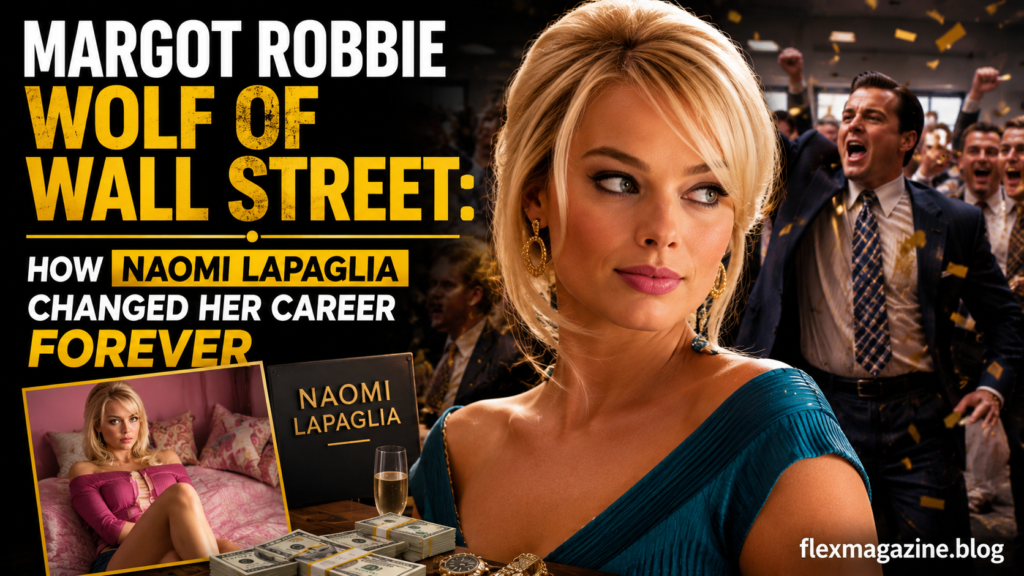

Who Did Margot Robbie Play in The Wolf of Wall Street?
Margot Robbie Wolf of Wall Street played Naomi Lapaglia, the second wife of stockbroker Jordan Belfort, in Martin Scorseses 2013 film The Wolf of Wall Street. Leonardo DiCaprio portrayed Belfort, while Jonah Hill, Kyle Chandler, Matthew McConaughey, and Rob Reiner appeared in other major roles.
Naomi enters the film as a confident and glamorous woman who quickly attracts Jordans attention. Their relationship becomes a central part of the story, reflecting the seduction, excess, instability, and eventual destruction surrounding his fraudulent financial empire.
The character is frequently remembered for her beauty and carefully designed fashion, but Robbies performance offers more than visual glamour. Naomi is outspoken, observant, ambitious, and capable of confronting Jordan in ways that many characters around him cannot.
As the marriage deteriorates, Naomi becomes one of the films clearest windows into the personal consequences of Jordans behavior. She witnesses the addiction, dishonesty, affairs, volatility, and emotional damage that accompany his pursuit of money and status.
The role became Margot Robbies international breakthrough. Although she had already worked in Australian television and an American drama series, The Wolf of Wall Street introduced her to a worldwide cinema audience and demonstrated that she could hold the screen opposite established stars.
What Is The Wolf of Wall Street About?
The Wolf of Wall Street is a biographical dark comedy directed by Martin Scorsese and written by Terence Winter. It is based on Jordan Belforts memoir about his career as a stockbroker and the rise and fall of his brokerage firm, Stratton Oakmont.
The film follows Belfort as he learns aggressive sales tactics, establishes a company, and becomes extraordinarily wealthy through manipulative stock schemes. His success brings luxury homes, expensive vehicles, extravagant parties, substance abuse, affairs, and increasingly reckless conduct.
Beneath the comedy and excess is a story about securities fraud and its consequences. Belforts firm sold questionable investments through high pressure tactics, enriching insiders while customers suffered financial losses.
The movies tone generated debate because Scorsese presents Belforts world with relentless energy and dark humor. Some viewers saw the approach as a sharp satire of greed, while others believed the film spent too much time displaying the lifestyle it was supposedly criticizing.
Released in the United States on December 25, 2013, the film became a major commercial success. It earned approximately $407 million worldwide against a reported production budget of around $100 million.
It also received five Academy Award nominations Best Picture, Best Director, Best Adapted Screenplay, Best Actor for Leonardo DiCaprio, and Best Supporting Actor for Jonah Hill. The Academys official record confirms the films five Oscar nominations.
Who Was Naomi Lapaglia Based On?
Naomi Lapaglia was inspired primarily by Nadine Macaluso, previously known as Nadine Caridi, who was Jordan Belforts second wife. The filmmakers changed her name and modified parts of her story for the movie.
Macaluso was a model when she met Belfort. Their relationship eventually led to marriage and two children, but it was affected by Belforts substance abuse, infidelity, criminal activity, and abusive conduct. The couple separated in the late 1990s, and their divorce was later finalized.
After leaving the marriage, Macaluso rebuilt her life and pursued an education in psychology. She earned advanced qualifications in counseling and somatic psychology and became a therapist specializing in relationships, trauma, and patterns of coercive control.
She also wrote Run Like Hell, a book drawing on her professional expertise and personal experiences. Her later work has focused on helping people identify unhealthy relationship dynamics and recover from abuse.
Naomi should not be treated as a completely accurate reproduction of Macaluso. She is a dramatized screen character shaped by Belforts memoir, Terence Winters screenplay, Martin Scorseses direction, and Robbies performance.
Some scenes were condensed, changed, or created for dramatic effect. Macaluso has stated publicly that she was not given creative control over the film and that certain incidents did not occur exactly as portrayed.
That distinction matters because audiences sometimes mistake a biographical movie for a documentary. The Wolf of Wall Street draws from real people and events, but it uses fictionalization, compression, and heightened storytelling.
Latest Update on the Real Naomi
Interest in Margot Robbies Wolf of Wall Street character increased again in July 2026 with the release of Paramount+ documentary series The Real Wolf of Wall Street. The production examines Belforts crimes and their consequences through a more explicitly documentary lens.
Archival interview footage of Nadine Macaluso appears in the series, directly connecting the real womans experiences with the dramatized Naomi Lapaglia seen in Scorseses film. Paramount+ identifies Macaluso as the inspiration for Robbies character.
The documentary has encouraged viewers to revisit both the film and the historical record. It shifts attention away from only the parties, money, and famous performances toward the people affected by Belforts conduct.
Macalusos present day career also adds context unavailable in the 2013 film. Her work as a therapist and author allows her to interpret her former relationship through professional knowledge about trauma, manipulation, and abusive dynamics.
This latest coverage does not erase the achievement of Robbies performance. Instead, it gives audiences another perspective from which to evaluate Naomi and the events the character represents.
Viewers can appreciate Robbies acting while recognizing that Macalusos real experiences were more complicated—and in important ways more painful—than a three hour Hollywood film could fully show.
How Margot Robbie Won the Role
Margot Robbies final audition for The Wolf of Wall Street has become one of Hollywoods most frequently repeated casting stories. During an intense scene opposite Leonardo DiCaprio, Robbie made a spontaneous decision that changed the direction of the audition.
The scene appeared to lead toward a kiss. Instead of following the expected romantic beat, Robbie slapped DiCaprio across the face. The unexpected choice reportedly surprised the room and impressed both DiCaprio and Martin Scorsese.
Robbie later said she briefly worried that hitting one of Hollywoods most famous actors might damage her career or get her into serious trouble. Instead, the improvisation demonstrated the fearlessness and emotional unpredictability needed for Naomi.
The choice was effective because it revealed an important truth about the character. Naomi was not meant to be a passive accessory in Jordans world. She needed the authority to challenge him, interrupt his control, and make the audience believe he could be destabilized by her.
Vanity Fair later reported that Robbies bold decision during the audition helped her secure the part. Vanity Fairs profile recounts the off script slap that contributed to her casting.
The story also illustrates Robbies instinct as a performer. She understood that a conventional reading might not distinguish her from other candidates. By making a choice grounded in Naomis personality, she transformed the audition into a memorable confrontation.
How Old Was Margot Robbie During the Movie?
Margot Robbie was approximately 22 years old during the production of The Wolf of Wall Street. She was born on July 2, 1990, and principal photography took place primarily in 2012.
She was 23 when the film reached theaters in December 2013. Her age surprised many viewers because she displayed unusual confidence opposite DiCaprio, who was already an internationally established star, and under the direction of Scorsese.
Robbie was not entirely new to professional acting. She had played Donna Freedman on the Australian soap opera Neighbours, appearing in hundreds of episodes and earning recognition in Australia.
After leaving Neighbours, she moved to the United States and joined the cast of ABCs period drama Pan Am. The series was cancelled after one season, but it gave Robbie experience performing for an American audience.
Landing The Wolf of Wall Street represented a dramatic increase in scale. She moved from television into a major film directed by one of cinemas most celebrated filmmakers and led by an Oscar nominated actor.
Her relative lack of Hollywood experience may have contributed to the freshness of the performance. Naomi appears to enter Jordans world with confidence and disruptive energy, much as Robbie entered the production prepared to make a strong impression.
How Robbie Created Naomi Lapaglia
Robbie approached Naomi as a character with her own strategy, intelligence, and survival instincts. She avoided portraying her solely as Jordans glamorous wife and worked to communicate what Naomi understood about the relationship.
Naomi recognizes the appeal of Jordans wealth, but she is not unaware of his flaws. Her attraction, ambition, anger, vulnerability, and eventual determination to leave exist together, making her more complicated than a simple romantic interest.
One of the most distinctive parts of the performance is Naomis Brooklyn accent. Robbie is Australian, and her ability to produce a convincing regional American voice helped audiences accept her immediately in the role.
She reportedly worked on the accent and studied the characters social environment. Her vocal delivery combines polish with sharpness, allowing Naomi to sound seductive in one scene and confrontational in another.
Costume design, hair, and makeup were also essential. Naomis appearance evokes the highly stylized wealth of the late 1980s and early 1990s, with bold colors, fitted silhouettes, dramatic jewelry, and carefully arranged hair.
Yet the performance does not disappear beneath the fashion. Robbie uses stillness, eye contact, timing, and vocal control to communicate when Naomi is calculating, disappointed, frightened, or furious.
The contrast between Naomis polished appearance and increasingly unstable home life becomes part of the films message. Luxury can decorate the environment, but it cannot repair the damage inside the marriage.
Working With Leonardo DiCaprio
Robbie and Leonardo DiCaprio needed to create a relationship that could move quickly from attraction to obsession, marriage, distrust, conflict, and collapse. Their screen chemistry gives the relationship its initial excitement, while their confrontations reveal its destructive foundation.
DiCaprios Jordan is constantly performing. He sells stocks, sells his own image, manipulates employees, and attempts to control the emotional reality around him. Naomi challenges that control because she is capable of seeing through the performance.
Robbie does not attempt to overpower DiCaprio through volume in every scene. She often uses restraint, watching Jordan carefully before changing the emotional direction of an exchange.
That control makes the larger confrontations more effective. When Naomi expresses anger or fear, the reaction feels connected to a long accumulation of betrayal rather than existing only for dramatic spectacle.
The relationship is not presented as a healthy romance. It involves infidelity, substance abuse, manipulation, intimidation, and violence. Robbies performance gradually shifts the audiences understanding of Naomi from an exciting part of Jordans fantasy to a person trying to protect herself and her children.
Although DiCaprio received the films leading actor Oscar nomination, Robbies work is essential to the domestic side of his character. Naomi forces viewers to see what Jordans behavior looks like when the party ends and the consequences enter his home.
Working With Martin Scorsese
Martin Scorsese was already one of the most respected directors in the world when Robbie joined the production. His filmography included Taxi Driver, Raging Bull, Goodfellas, Casino, The Departed, and numerous other acclaimed works.
For a young actor in her first major Hollywood film, the scale of the opportunity could have been overwhelming. Robbie has discussed feeling nervous during the production, particularly during its early stages.
Scorsese is known for allowing actors room to explore behavior and improvisation while maintaining strong control of tone and narrative. That environment suited Robbies willingness to make assertive character choices.
Her successful audition already demonstrated that she could improvise without losing the emotional purpose of a scene. During filming, that same confidence helped her portray Naomi as more than a visual symbol of Jordans success.
Robbie has also spoken about advocating for choices she believed matched Naomis psychology. In discussing one particularly sensitive sequence, she explained that Scorsese offered a less revealing alternative, but she felt the character would use complete confidence as a form of power in that moment.
The relevant point is not the amount of exposure in the finished scene. It is that Robbie made a deliberate acting choice based on what she believed Naomi was attempting to achieve.
Handling the Films Sensitive Scenes
The Wolf of Wall Street carries an R rating in the United States and includes strong language, substance abuse, sexual material, nudity, and violence. Naomis role required Robbie to work through scenes that were emotionally and physically exposed.
Robbie has spoken openly about the preparation and professionalism involved. Such sequences are created through blocking, camera placement, closed set procedures, wardrobe planning, and coordination among the performer, director, cinematographer, and production team.
Public discussion sometimes reduces her role to those moments, which overlooks the broader performance. Naomis most important function is not simply to represent attraction or luxury she exposes the limits of Jordans ability to control everyone around him.
The later domestic scenes require Robbie to portray fear, anger, exhaustion, and maternal protectiveness. These sequences give the character emotional weight and prevent her from remaining only an emblem of excess.
Modern discussions about filming intimate material often emphasize consent, communication, and the use of intimacy coordinators. Industry practices in 2012 were not identical to those common on many major sets today.
Robbies reflections should be understood in the context of her own choices and experiences. They should not be turned into general assumptions about what every performer should be willing to do for a role.
What Naomi Represents in the Story
Naomi initially represents the lifestyle Jordan believes money can purchase. She is introduced through his gaze as part of an expanding collection of status symbols that includes homes, cars, clothing, a yacht, and social power.
That framing is intentional because the film is largely told from Jordans perspective. He tends to evaluate people according to what they can provide, how they affect his image, or whether he can control them.
Robbie gradually complicates that viewpoint. Naomi has preferences, boundaries, emotional needs, and the ability to withdraw. She cannot be reduced permanently to another possession.
Her growing resistance also signals the collapse of Jordans private world. Law enforcement threatens his business from the outside, while distrust and fear destroy his marriage from within.
Naomis decision to protect herself and her children represents a form of reality Jordan cannot successfully sell his way out of. The charm and aggressive persuasion that work in a sales room become ineffective when the damage is too severe.
This is one reason Robbies performance remains memorable. She enters the movie as part of the fantasy but ultimately helps expose that fantasys human cost.
Differences Between Naomi and Nadine Macaluso
Naomi Lapaglia is not a literal scene by scene recreation of Nadine Macalusos life. The characters name was changed, and parts of her biography, relationships, dialogue, and experiences were adapted for dramatic storytelling.
The movie draws heavily from Jordan Belforts memoir, meaning the underlying account is connected to his perspective. Any story told primarily through Belfort is likely to emphasize his interpretation of events.
Macaluso has said that she met Robbie before filming and helped with aspects such as the Brooklyn accent. However, she was not a producer or screenwriter and did not control the finished portrayal.
In later interviews, she challenged or clarified several scenes. Some incidents were compressed or invented, while other parts of the real relationship were more troubling than the film communicated.
A responsible viewer should therefore distinguish three different people the real Nadine Macaluso, the memoirs description of Belforts second wife, and the fictionalized Naomi Lapaglia portrayed by Robbie.
Robbies job was to interpret the screenplay, not create a documentary impersonation. Her performance can be dramatically effective even when the films version differs from historical reality.
The renewed attention surrounding Macalusos therapeutic work and documentary appearances helps restore her individual identity. She is not simply the real Naomi she is a professional, author, mother, and survivor with a life extending far beyond Belforts story.
Reviews of Margot Robbies Performance
Reviews of The Wolf of Wall Street frequently recognized Robbie as a standout, particularly because she held her own within a loud, fast moving film dominated by DiCaprios performance.
Critics noted her screen presence, comic timing, accent, and ability to shift Naomi from an object of desire into a force capable of confronting Jordan. Her performance prevented the character from becoming entirely one dimensional.
The film itself received broadly positive reviews. Rotten Tomatoes critical consensus describes it as funny, self aware, and powered by the energetic collaboration between Scorsese and DiCaprio. Rotten Tomatoes maintains an overview of the films critical reception.
Not all critics responded positively to the movies tone. Some argued that its lengthy presentation of wealth, drugs, and destructive behavior risked glamorizing Belfort instead of condemning him.
Others saw the excess as deliberate satire. From that perspective, the film overwhelms the audience with repetition until Jordans behavior appears empty, grotesque, and self destructive.
Robbie was not nominated for an Academy Award for the role, but the absence of a nomination did not limit its career impact. Naomi became one of the films most recognizable characters and immediately established Robbie as a major Hollywood presence.
In retrospect, many viewers consider the performance an early demonstration of qualities Robbie developed further in I, Tonya, Bombshell, Once Upon a Time in Hollywood, Babylon, and Barbie.
How the Role Changed Margot Robbies Career
Before The Wolf of Wall Street, Robbie was best known for Neighbours and Pan Am. After its release, she became an internationally recognized actor offered major studio roles.
Her next projects included Focus opposite Will Smith and The Legend of Tarzan. She then took on the role of Harley Quinn in Suicide Squad, creating another character strongly associated with her public image.
Rather than relying only on acting offers, Robbie co founded LuckyChap Entertainment with Tom Ackerley, Josey McNamara, and Sophia Kerr. The company allowed her to participate in developing and producing projects.
LuckyChap produced I, Tonya, which earned Robbie her first Academy Award nomination for acting. It later participated in projects including Promising Young Woman, Maid, Saltburn, and Barbie.
Robbie received additional Oscar nominations for Bombshell and as a producer of the Best Picture nominee Barbie. Her evolution from breakout performer to influential producer shows how effectively she used the opportunities created by Naomi.
The Wolf of Wall Street role did not define the limits of her career. It gave her visibility, but her later choices demonstrated range across comedy, drama, comic book films, period pieces, independent cinema, and major commercial productions.
The greatest effect of Naomi Lapaglia was therefore access. The performance made Hollywood pay attention Robbies later work proved that the attention was justified.
Why Is Margot Robbie Wolf of Wall Street Trending?
The keyword is trending again partly because The Real Wolf of Wall Street premiered in July 2026. The documentary renews public discussion about Belfort, Stratton Oakmont, his victims, and the people represented in Scorseses film.
Nadine Macalusos participation through archival material has generated particular interest in the differences between her life and Naomi Lapaglia. Viewers want to know what the movie changed and how Macaluso rebuilt her life.
Robbies continued visibility also brings audiences back to her breakthrough. Her later success as the star and producer of Barbie, her acclaimed dramatic performances, and her 2026 film work encourage people to revisit where her Hollywood rise began.
Short clips from the film continue circulating on TikTok, YouTube, Instagram, and other platforms. The audition story involving DiCaprio also resurfaces regularly because it offers a compelling example of an actor taking a creative risk.
Streaming accessibility gives the film a long afterlife. New viewers encounter it each year, while existing fans return to discuss the performances, true story, fashion, controversies, and financial crimes.
The result is a keyword that serves several audiences at once Robbie fans, film enthusiasts, people researching Jordan Belfort, viewers interested in the real Naomi, and readers curious about famous Hollywood casting stories.
Conclusion
Margot Robbies performance in The Wolf of Wall Street remains one of the most influential breakthrough roles of modern Hollywood. As Naomi Lapaglia, she combined glamour, humor, confidence, anger, vulnerability, and emotional control in a film filled with larger than life performances.The character was inspired by Nadine Macaluso, but Naomi should not be mistaken for a completely accurate portrait. The film adapts Belforts memoir, changes names, compresses events, and uses fictionalized scenes to create its narrative.Robbies off script decision during her audition helped her secure the role, but one daring moment alone did not create the performance. Her accent, timing, character analysis, screen presence, and ability to challenge DiCaprio made Naomi memorable.
You may also read more blogs
FAQs
Who did Margot Robbie play in The Wolf of Wall Street?
Margot Robbie played Naomi Lapaglia, Jordan Belforts second wife. Naomi becomes an important figure in the films depiction of Belforts rise, extravagant lifestyle, and personal collapse.
How old was Margot Robbie in The Wolf of Wall Street?
Robbie was approximately 22 during principal photography in 2012. She was 23 when the movie was released in December 2013..
Was Naomi Lapaglia a real person?
There was no real person named Naomi Lapaglia in Belforts life. The character was primarily inspired by his second wife, Nadine Macaluso.
How did Margot Robbie get the role?
Robbie secured the part after a memorable audition with DiCaprio. During an intense exchange, she departed from the expected romantic ending and slapped him across the face..
Did Margot Robbie use her real accent?
No. Robbie is Australian, but she performed Naomi with a Brooklyn style American accent.
Did Margot Robbie win an Oscar for the movie?
No. Robbie did not receive an Academy Award nomination for The Wolf of Wall Street, although the film earned five nominations.
Was The Wolf of Wall Street Margot Robbies first movie?
No. Robbie had appeared in Australian films and television before the Scorsese production. She was particularly well known in Australia for playing Donna Freedman on Neighbours.
Did the real Naomi approve of the movie?
Nadine Macaluso did not have creative control over the film and has clarified that parts of the story were changed or invented. She reportedly met Robbie and assisted with details such as the accent.