
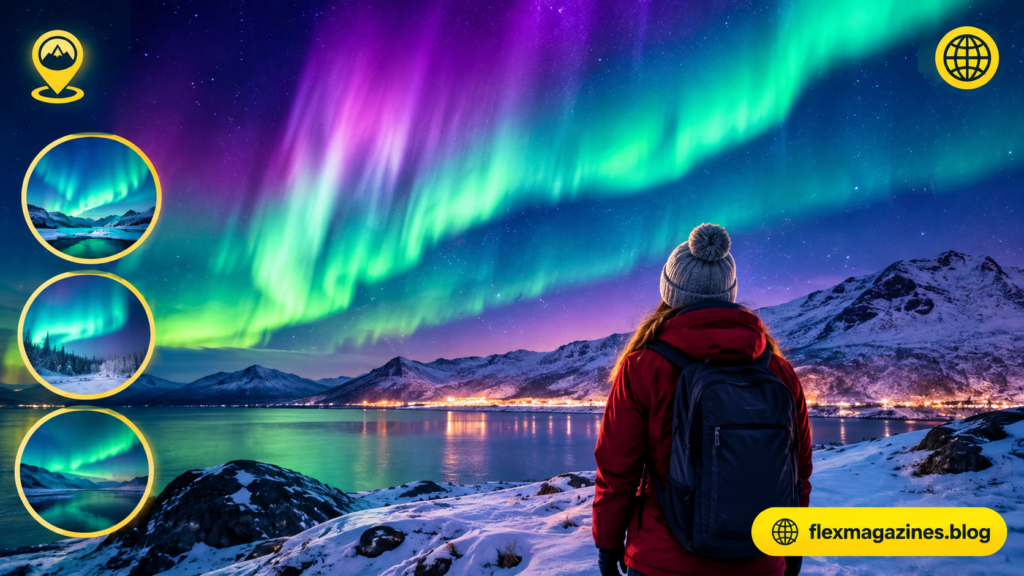

The best places to see Northern Lights are destinations located beneath or close to the auroral oval, where travelers can combine high aurora potential with dark skies and reasonably favorable weather.
For most first time travelers, Finnish Lapland, Tromsø in Norway, Abisko in Sweden, Iceland, and Fairbanks in Alaska are among the strongest choices. Each offers a different experience.
Finnish Lapland is ideal for travelers who want Arctic scenery, wilderness, glass roof cabins, and a comfortable resort experience. Tromsø combines a lively Arctic city with easy access to northern lights tours. Abisko is particularly attractive for travelers who prioritize viewing conditions and dark skies. Iceland is excellent for combining aurora hunting with road trips, waterfalls, glaciers, and dramatic landscapes. Fairbanks is one of the leading choices in North America.
There is one important reality to understand before booking no destination can guarantee the Northern Lights. Aurora visibility depends on solar activity, darkness, cloud cover, local weather, and your location.
The smartest strategy is therefore not simply choosing a famous destination. It is choosing a location with good aurora potential, staying several nights, getting away from artificial light, and remaining flexible enough to follow changing weather conditions.
Why Some Places Are Better for Northern Lights
The Northern Lights, also called the Aurora Borealis, occur when charged particles associated with solar activity interact with Earths atmosphere.
The aurora is concentrated in a broad region around the magnetic north known as the auroral oval. This makes high latitude destinations across northern Scandinavia, Iceland, Greenland, Alaska, and Canada particularly attractive for aurora travelers.
But latitude alone does not determine whether you will see the lights.
Three conditions are especially important
Darkness
You need a sufficiently dark sky. Even strong auroras can be difficult to see during daylight or bright twilight.
Clear Skies
Clouds can completely block an otherwise spectacular aurora.
This is why weather can sometimes matter more than the strength of the aurora forecast.
Aurora Activity
The Northern Lights are driven by space weather. When solar activity creates favorable conditions, auroras can become brighter and more widespread.
This is why an excellent destination can produce a disappointing night—and a quiet looking location can occasionally deliver an extraordinary show.
Best Northern Lights Destinations at a Glance
| Destination | Best For | Typical Aurora Season | Main Advantage |
| Finnish Lapland | Luxury & families | Late Aug–early Apr | Dark wilderness and glass cabins |
| Tromsø, Norway | First time visitors | Late Aug–early Apr | Arctic city + easy tours |
| Abisko, Sweden | Reliability | Sep–Mar | Clear sky reputation |
| Iceland | Road trips | Late Aug–late Apr | Aurora + dramatic scenery |
| Fairbanks, Alaska | U.S. travelers | Aug 21–Apr 21 | Strong aurora viewing infrastructure |
| Yellowknife, Canada | Serious aurora hunters | Late summer–spring | Excellent dark skies |
| Greenland | Adventure | Late Aug–Apr | Minimal light pollution |
| Northern Scotland | UK travelers | Autumn–winter | Accessible European alternative |
| Alta, Norway | Quieter Arctic experience | Autumn–spring | Less urban than Tromsø |
| Lofoten, Norway | Photography | Autumn–spring | Mountains, beaches and aurora |
Seasons vary by location, weather, daylight, and annual conditions. Treat these as planning windows rather than guarantees.
Finnish Lapland Best for a Magical Arctic Vacation
If your idea of a Northern Lights trip includes snow covered forests, reindeer, cozy cabins, saunas, and the possibility of watching the aurora from bed, Finnish Lapland is difficult to beat.
The region stretches across northern Finland and offers a combination of Arctic wilderness and tourist infrastructure that makes it especially appealing to first time visitors.
Visit Finland says the Northern Lights season in Finnish Lapland generally runs from late August through early April, with September–October and February–March highlighted as particularly favorable periods for aurora activity.
Best places in Finnish Lapland
Consider
- Rovaniemi
- Levi
- Inari
- Saariselkä
- Ylläs
- Salla
- Kilpisjärvi
Rovaniemi is convenient for travelers who want attractions and activities alongside aurora hunting. Inari and more remote parts of Lapland can provide a stronger wilderness atmosphere.
Why choose Finnish Lapland?
The region is especially appealing because Northern Lights viewing can be combined with other Arctic experiences.
You can spend the day
- Snowshoeing
- Skiing
- Riding a sled
- Visiting a reindeer farm
- Exploring national parks
- Relaxing in a sauna
Then head outside after dark to look for the aurora.
Visit Finland also highlights glass roofed cabins and other specialized accommodations designed specifically for viewing the Northern Lights.
Best for
Couples, families, luxury travelers, first time aurora hunters, and travelers who want the Northern Lights to be part of a broader Arctic vacation.
Tromsø, Norway Best for First Time Aurora Travelers
Tromsø is one of the most popular Northern Lights destinations in the world, and for good reason.
The city sits within the auroral zone and combines an urban base with access to Arctic wilderness.
Visit Tromsø says the Northern Lights may be visible in the region from late August to early April, provided the sky is dark and sufficiently clear.
The city is particularly useful for travelers who do not want to spend their entire vacation in a remote wilderness location.
You can stay in a hotel, eat at restaurants, visit museums, and enjoy Arctic activities during the day. At night, you can join a Northern Lights tour or travel outside the city in search of clearer skies.
Why Tromsø is so popular
The biggest advantage is flexibility.
If clouds cover one area, guided tours can sometimes travel toward locations with better conditions. Visit Tromsø specifically notes that organized tours may travel beyond the city when local conditions are challenging.
The surrounding region also offers
- Fjords
- Mountains
- Dog sledding
- Snowshoeing
- Sami cultural experiences
- Whale watching
- Arctic cuisine
When to visit Tromsø
Northern Lights trips are possible from late August through early April, but conditions vary considerably throughout the season.
Autumn can offer less snow and relatively mild conditions, while winter provides the classic snowy Arctic landscape.
Best for
First time visitors, couples, photographers, international travelers, and anyone who wants a balance between city comfort and Arctic adventure.
Abisko, Sweden Best for Aurora Focused Trips
For travelers whose main objective is simply to see the Northern Lights, Abisko deserves serious consideration.
Located in Swedish Lapland near Kiruna, Abisko has developed a reputation for favorable viewing conditions.
Visit Sweden describes Abisko National Park as one of the worlds notable Northern Lights destinations and highlights the areas tendency to experience clearer skies than nearby areas under certain weather patterns.
That reputation is connected partly to local geography.
Mountains surrounding the area can influence weather patterns, creating what is often called the Abisko blue hole effect.
Aurora Sky Station
One of Abiskos signature attractions is the Aurora Sky Station, located on Mount Nuolja.
Visitors can reach elevated viewpoints and enjoy panoramic views of the surrounding landscape.
For a Northern Lights trip where the aurora itself is the centerpiece, this can be a compelling experience.
When to visit
Visit Sweden recommends roughly September through March, with the darkest months offering long viewing opportunities.
Best for
Serious aurora hunters, photographers, nature travelers, and people willing to prioritize viewing conditions over nightlife or big city amenities.
Iceland Best for Northern Lights Road Trips
Iceland offers something few destinations can match the Northern Lights are only one part of the adventure.
During an Iceland trip, you can combine aurora hunting with
- Waterfalls
- Glaciers
- Volcanoes
- Geothermal pools
- Black sand beaches
- Lava fields
- Coastal landscapes
- Small fishing towns
That makes Iceland particularly attractive to travelers who do not want their entire vacation to depend on aurora visibility.
Visit Iceland states that the aurora season generally runs from late August through late April and emphasizes the importance of darkness and sufficiently clear skies.
Where should you stay?
Reykjavík is convenient, but city light pollution can reduce viewing quality.
For stronger dark sky opportunities, consider traveling away from the capital and other heavily illuminated areas.
The countryside gives you more opportunities to combine the aurora with dramatic foregrounds.
One important Iceland tip
Do not obsess over the Kp index alone.
Visit Iceland specifically warns travelers against relying too heavily on Kp as a simple predictor of what they will see from a particular location. Local cloud conditions and real time space weather information matter too.
Best for
Road trippers, photographers, couples, adventure travelers, and people who want a complete destination rather than an aurora only vacation.
Fairbanks, Alaska Best Northern Lights Destination in the United States
For travelers searching for the best place to see the Northern Lights in the United States, Fairbanks is one of the first destinations to consider.
The citys location beneath the auroral oval, relatively dry interior climate, and established aurora tourism infrastructure make it a strong North American option.
Explore Fairbanks lists its official Aurora Season as August 21 through April 21.
The area also has a wide range of dedicated viewing options.
Travelers can watch from
- Heated aurora cabins
- Lodges
- Domes
- Yurts
- Remote viewing areas
- Dog sled tours
- Snowmobile excursions
- Ice fishing trips
Best viewing areas around Fairbanks
Explore Fairbanks highlights locations including
- Creamers Field
- Cleary Summit
- Chena River State Recreation Area
- Chena Lake Recreation Area
- Murphy Dome
Some remote locations require extra care during winter because of snow, road conditions, limited services, and inconsistent cell coverage.
Why Fairbanks stands out
You do not necessarily need to travel deep into the wilderness to hunt for the aurora.
There are viewing opportunities close to the city, while more remote locations can offer darker skies.
The local tourism organization also provides an Aurora Tracker combining aurora forecasts, weather information, and daylight conditions.
Best for
U.S. travelers, photographers, adventure travelers, and visitors who want a well developed Northern Lights tourism infrastructure.
Yellowknife, Canada A Strong Choice for Dark Skies
Canadas northern territories offer some of the worlds most impressive aurora conditions.
Yellowknife, in Canadas Northwest Territories, is particularly well known among Northern Lights travelers.
Its northern position and relatively dry climate can create excellent conditions when the sky is clear.
The destination is especially attractive to people who want to make the aurora the central focus of their trip rather than simply hoping to see it while visiting another attraction.
What makes Yellowknife different?
The experience is strongly connected to the wilderness.
Travelers can combine aurora viewing with
- Winter landscapes
- Indigenous cultural experiences
- Snow activities
- Outdoor adventures
- Remote lodges
It can feel less like a conventional European city break and more like a dedicated Arctic expedition.
Best for
Dedicated aurora travelers, photographers, wilderness enthusiasts, and North American travelers looking for an alternative to Alaska.
Greenland Best for Remote Arctic Scenery
Greenland offers an entirely different Northern Lights experience.
Rather than focusing on a major tourist city, travelers can find themselves beneath the aurora surrounded by enormous landscapes, ice, mountains, and very little artificial light.
Visit Greenland describes the Northern Lights season as generally running from late August to April, when darkness returns to the Arctic.
Why Greenland is special
Imagine photographing the aurora above
- Icebergs
- Glaciers
- Snow covered mountains
- Fjords
- Arctic settlements
The scenery can make an already spectacular natural phenomenon feel even more dramatic.
Kangerlussuaq
Kangerlussuaq is particularly interesting for travelers seeking aurora focused experiences, including tours toward the Greenland Ice Sheet.
Ilulissat
Ilulissat provides the opportunity to combine Northern Lights viewing with the spectacular Ilulissat Icefjord and surrounding Arctic scenery.
Best for
Photographers, adventurous travelers, wilderness lovers, and travelers looking for an unusual Arctic experience.
Northern Scotland Best Alternative for UK Travelers
You do not necessarily have to travel to the Arctic Circle to have a chance of seeing the Aurora Borealis.
Northern Scotland can occasionally deliver spectacular displays, particularly during periods of strong auroral activity.
VisitScotland highlights Shetland, Caithness, the North Coast 500 region, Wester Ross, Applecross, and the Cairngorms among places where travelers can look for the aurora.
Shetland
Shetland is particularly interesting because of its northern latitude and dark rural landscapes.
The local name for the Northern Lights is Mirrie Dancers.
Away from streetlights, locations such as Eshaness and parts of Shetlands northern coastline can offer broad horizons for aurora watching.
The major advantage
Scotland is a much more accessible option for travelers already visiting the United Kingdom.
But expectations should be realistic.
The Northern Lights are less consistently visible there than in destinations directly beneath the auroral oval.
Best for
UK travelers, repeat aurora hunters, photographers already exploring Scotland, and travelers who want to combine aurora watching with a Highlands vacation.
Northern Norway Beyond Tromsø
Tromsø gets much of the attention, but it is not the only place in northern Norway worth considering.
Visit Norway highlights destinations including
- Alta
- Lofoten
- Senja
- Vesterålen
- Kirkenes
- North Cape
- Lyngenfjord
- Bodø
- Kautokeino
- Karasjok
Northern Norways official tourism organization notes that the aurora season can extend from late September into late March, with autumn and spring statistically favorable for aurora activity.
Alta
Alta is a strong alternative for travelers who want an Arctic destination with less of the major tourist city atmosphere of Tromsø.
Lofoten
Lofoten is especially appealing to photographers.
The combination of dramatic mountains, fishing villages, beaches, and the Northern Lights can create extraordinary compositions.
The trade off is that coastal weather can be unpredictable, so cloud cover deserves close attention.
Senja
Senja offers dramatic landscapes and fewer crowds than some of Norways most famous Arctic destinations.
Best for
Photographers, repeat visitors, road trippers, and travelers who want northern Norway without spending their entire trip in Tromsø.
When Is the Best Time to See the Northern Lights?
There is no single perfect month everywhere.
Generally, the Northern Lights can be seen during the darker months of the year in high latitude regions.
For many destinations, the practical viewing season falls somewhere between late August and April, depending on latitude and local daylight conditions.
Finland lists late August to early April for Lapland, Iceland describes late August to late April, Tromsø generally uses late August to early April, while Fairbanks defines its aurora season as August 21 to April 21.
September and October
These months can be excellent for travelers who want
- Dark nights
- Less extreme cold
- Autumn landscapes
- Potentially fewer winter crowds
The disadvantage is that snow may be limited or absent in some locations.
November through January
These months offer very long nights and classic winter scenery.
The downside is colder weather and, depending on the destination, more difficult travel conditions.
February and March
Late winter is often an excellent compromise.
You can get
- Long dark nights
- Snow covered scenery
- Winter activities
- Increasing daylight for daytime sightseeing
Visit Finland identifies September–October and February–March as peak months in its Finland specific guidance.
What Time of Night Is Best?
There is no guaranteed hour when the aurora will appear.
It can happen at different times depending on solar and local conditions.
In Tromsø, official tourism guidance says auroras can appear at any point during the night, although activity is often seen between approximately 8 p.m. and 2 a.m.
Visit Iceland similarly recommends being outside around the late evening period, noting that auroras are on average frequently seen around 11 p.m. there.
The practical lesson is simple
Do not arrive at 1000 p.m., look for five minutes, and leave.
Give the sky time.
How to Increase Your Chances of Seeing the Northern Lights
Even the best destination cannot overcome poor planning.
Stay for Several Nights
A one night trip is a gamble.
A multi night stay gives you multiple opportunities to encounter
- Clear skies
- Stronger auroral activity
- Better viewing locations
The more flexibility you have, the better.
Get Away From Artificial Light
Light pollution makes faint auroras harder to see.
You do not always need to travel hours into the wilderness. Even moving outside a brightly lit city center can make a major difference.
Monitor Cloud Cover
A strong aurora behind thick clouds is still invisible.
Always check local weather alongside aurora forecasts.
Be Flexible
If a tour operator tells you conditions are better in another direction, be prepared to move.
This is especially useful in destinations such as Tromsø, where guided tours may travel to search for clearer skies.
Dress Properly
Aurora hunting often means standing outside for a long time.
Wear
- Thermal base layers
- Insulating mid layers
- Waterproof outer layers
- Warm socks
- Insulated boots
- Gloves
- Hat
- Neck protection
In very cold destinations, having proper clothing is not a luxury. It can determine how long you are willing to remain outside.
How to Read a Northern Lights Forecast
Aurora forecasts can look intimidating at first.
You may encounter terms such as
- Kp index
- Solar wind
- Bz
- Solar wind speed
- Cloud cover
- Geomagnetic activity
- Auroral oval
Do not reduce the entire forecast to a single number.
A high Kp value does not automatically mean you will see a spectacular display from your exact hotel.
Your local sky still needs to be dark and clear.
Visit Iceland specifically advises travelers not to rely too heavily on Kp alone and recommends paying attention to real time space weather information, including the Bz component.
The most useful approach is to combine
Aurora activity + local cloud forecast + darkness + location.
Should You Book a Northern Lights Tour?
For first time visitors, a guided tour can be worthwhile.
A good guide may help with
- Finding darker locations
- Monitoring weather
- Following aurora forecasts
- Transportation
- Photography
- Local safety
- Warmth and shelter
Tours are particularly useful if you do not want to drive unfamiliar Arctic roads at night.
However, independent travelers may prefer renting a car and choosing their own locations.
The right choice depends on your comfort level, driving experience, weather conditions, and destination.
Northern Lights Photography Tips
Modern smartphones can often capture auroras better than your eyes might expect, but dedicated cameras still provide more control.
Use a Tripod
Long exposures amplify camera movement.
A sturdy tripod is one of the most useful pieces of equipment for aurora photography.
Use Manual Controls
If your camera allows it, experiment with
- Wide aperture
- Higher ISO
- Shorter exposure for fast moving aurora
- Longer exposure for dimmer displays
The exact settings depend on your camera, lens, aurora brightness, and surrounding light.
Carry Spare Batteries
Cold temperatures can reduce battery performance.
Keep spare batteries protected from extreme cold when possible.
Include Foreground Scenery
An aurora photograph becomes much more memorable when the frame includes something recognizable
- Cabin
- Mountain
- Tree line
- Iceberg
- Fjord
- Lake
- Road
- Village
This is one reason Iceland, Lofoten, Greenland, and Finnish Lapland are so popular with photographers.
Common Northern Lights Trip Mistakes
Choosing the Destination Only for Its Reputation
A famous destination can still have clouds.
Research local weather patterns and viewing geography.
Staying Only One Night
This gives nature almost no room to cooperate.
Several nights are much more sensible.
Ignoring Moonlight
A bright moon does not automatically prevent aurora viewing, but it changes the appearance of the sky and landscape.
Some photographers actually prefer moonlight because it illuminates foreground scenery.
Spending the Entire Trip in a City Center
Urban convenience is useful, but excessive artificial light can reduce viewing quality.
Plan at least some time in darker areas.
Assuming the Forecast Is a Guarantee
Aurora forecasts are predictions, not promises.
Even strong solar activity does not guarantee clear skies at your location.
Which Northern Lights Destination Is Best for You?
Choose Finnish Lapland if…
You want a comfortable Arctic vacation with
- Glass cabins
- Snow activities
- Saunas
- Reindeer
- Family friendly experiences
Choose Tromsø if…
You want
- Easy access
- Hotels and restaurants
- Guided tours
- Arctic city life
- Fjords and mountains
Choose Abisko if…
Your priority is
- Aurora viewing
- Dark skies
- Wilderness
- Photography
- A quieter experience
Choose Iceland if…
You want to combine the aurora with
- Road trips
- Waterfalls
- Glaciers
- Volcanoes
- Geothermal attractions
Choose Fairbanks if…
You are traveling from the United States or want
- Strong Arctic infrastructure
- Dedicated aurora tours
- Remote viewing areas
- Alaska wilderness
Choose Yellowknife if…
You want a North American destination where the Northern Lights are the main event.
Choose Greenland if…
You want
- Remote landscapes
- Icebergs
- Glaciers
- Minimal light pollution
- A more adventurous experience
Choose Northern Scotland if…
You are already visiting the UK and want an opportunity to see auroras without traveling to the far north of Scandinavia or North America.
Conclusion
The best places to see Northern Lights all share the same fundamental ingredients northern latitude, dark skies, favorable weather, and access to the auroral zone.But the best destination for you depends on the kind of trip you want.For a comfortable and magical Arctic vacation, Finnish Lapland is hard to beat. For a convenient first aurora trip, Tromsø is an excellent choice. For travelers who want to maximize the viewing experience, Abisko deserves serious consideration. Iceland is ideal for combining aurora hunting with a spectacular road trip, while Fairbanks is one of the strongest choices in North America.For a more remote adventure, consider Greenland or northern Canada. And if youre already traveling through the UK, northern Scotland can provide a realistic opportunity under the right conditions.The most important lesson is not to chase a guarantee that does not exist.Instead, choose a strong aurora destination, stay several nights, escape light pollution, monitor both cloud cover and space weather, dress for the conditions, and give nature time to perform.When the sky finally turns green, purple, pink, or white above an Arctic landscape, the waiting becomes part of the experience.
You may also read more blogs
FAQs
What is the best place in the world to see the Northern Lights?
There is no universally best location because viewing depends on darkness, cloud cover, aurora activity, and local geography. Finnish Lapland, Tromsø, Abisko, Iceland, Fairbanks, and northern Canada are among the strongest choices.
What month is best for seeing the Northern Lights?
September through March is a strong general planning window in many Northern Lights destinations, although the exact season varies. Finland, for example, identifies late August through early April as its main aurora season.
How many nights should I stay to see the Northern Lights?
A stay of several nights is preferable to a one night trip because the aurora depends on changing space weather and weather conditions. More nights provide more opportunities for clear skies and active aurora.
Can you see the Northern Lights with the naked eye?
Yes. Under sufficiently dark skies and favorable conditions, auroras can be visible without a camera. A camera can sometimes capture colors and detail that are difficult for the human eye to distinguish in low light.
Is Iceland or Norway better for Northern Lights?
Neither is universally better. Norway, particularly northern Norway, offers excellent aurora viewing combined with Arctic fjords and mountains. Iceland adds the ability to combine aurora hunting with dramatic geological landscapes and road trips. Your priorities should determine the choice.
Is Fairbanks the best place to see the Northern Lights in the U.S.?
Fairbanks is widely regarded as one of the strongest U.S. destinations for aurora viewing because of its location beneath the auroral oval and its established viewing infrastructure. Its official aurora season runs from August 21 to April 21.
Can you see the Northern Lights in summer?
In high latitude locations, the aurora can occur during summer, but daylight and twilight can make it impossible or very difficult to see. The practical viewing season therefore focuses on darker months.
Do I need a Northern Lights tour?
No. You can view the aurora independently if you have suitable transportation, a safe viewing location, appropriate clothing, and access to reliable weather and aurora information. A guided tour can make the experience easier, especially for first time visitors.