
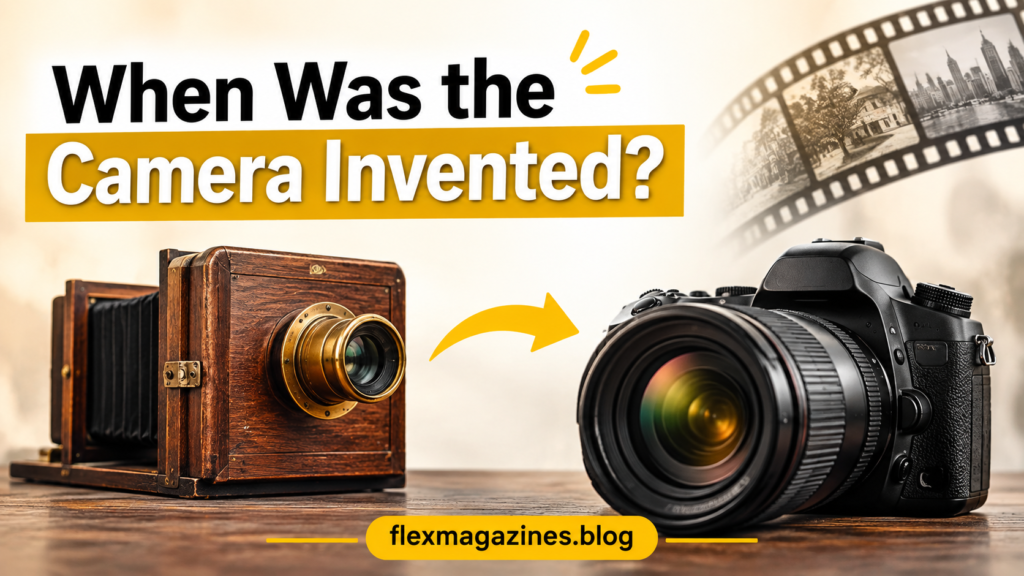

The camera does not have one universally accepted invention date because it developed through several stages.
The earliest concept behind a camera dates back centuries to the camera obscura, a darkened room or box that used a small opening to project an image of the outside world onto a surface. However, the camera obscura could only project an image it could not permanently record one.
The development of a true photographic camera came much later.
French inventor Joseph Nicephore Niepce created what is generally regarded as the worlds earliest surviving permanent photograph around 1826 or 1827. He used a camera and a light sensitive substance to capture an image from a window of his estate in France. Smithsonian records also identify Niepces early heliographic work as a key milestone in photography.
A second major milestone came in 1839, when Louis Daguerres daguerreotype process was publicly introduced. This date is often treated as the beginning of practical photography because the new process made photographic images available to a much wider audience. The Smithsonian notes that historians often use 1839 as photographys first year because that was when the new medium was introduced to the world, even though photographic experiments had begun much earlier.
So, if youre looking for the simplest answer to when was the camera invented, the best explanation is
The cameras earliest roots go back to the camera obscura, but the first successful photographic camera dates to the 1820s, with Niepces permanent photograph around 1826–1827. Practical photography emerged publicly in 1839 with Daguerres process.
What Was the First Camera?
The first photographic cameras were very different from the cameras people use today.
They were essentially dark boxes equipped with a lens or opening that directed light onto a light sensitive material.
The concept depended on a simple principle light travels in straight lines. If light enters a darkened chamber through a small opening, it can form an image of the scene outside on the opposite surface.
This principle had been understood long before photography.
The revolutionary step was finding a way to record that projected image permanently.
Niepce was one of the first people to successfully combine a camera with a photosensitive material to create a lasting image.
His process was called heliography, meaning sun drawing.
The surviving image associated with Niepce is commonly known as View from the Window at Le Gras. It is believed to date to approximately 1826 or 1827.
The Smithsonian describes Niepces image as the photograph generally considered to be among the earliest surviving examples of photography.
The Camera Obscura Came First
To understand when the camera was invented, it helps to separate the camera from the photographic camera.
The word camera is related to the Latin word for room or chamber.
The camera obscura, literally dark chamber, was an early optical device that projected an external scene onto an interior surface.
It could take several forms.
A camera obscura might be
- An entire darkened room
- A portable wooden box
- A small chamber with a pinhole
- A box containing lenses and mirrors
The image produced inside the device could be viewed or traced by an artist.
However, there was one major limitation.
The image disappeared when the light source was removed.
There was no permanent photograph.
That meant the camera obscura was an important ancestor of the camera, but it was not a photographic camera in the modern sense.
How Did the Camera Obscura Work?
The principle was surprisingly simple.
Imagine a completely dark room with a tiny hole in one wall.
Light from the outside scene enters through that hole.
Because light rays travel in straight lines, rays from the top of the scene travel toward the lower part of the opposite wall, while rays from the bottom travel toward the upper part.
The result is an upside down image.
A lens can improve the brightness and sharpness of the projected image.
Artists and scientists used this optical phenomenon for centuries.
The invention of photography required another breakthrough a material that would react to light and preserve the projected image.
That breakthrough took place in the nineteenth century.
Who Invented the Photographic Camera?
There is no single inventor who can be credited with every aspect of the camera.
However, Nicephore Niepce is one of the most important names in the answer because he produced an early permanent photograph using a camera.
Niepce was a French inventor who experimented with light sensitive materials and methods for creating permanent images.
His work eventually produced the famous View from the Window at Le Gras.
The image required a very long exposure because early photographic materials were extremely insensitive to light.
The process was nothing like taking a photograph with a modern phone.
Instead of pressing a button and immediately viewing an image, early photography involved carefully preparing materials, positioning the camera and waiting for light to create a visible image.
When Was the First Photograph Taken?
The first permanent photograph is generally associated with Nicephore Niepce around 1826 or 1827.
There is some historical uncertainty over the exact date, which is why reputable sources sometimes give slightly different years.
Smithsonian material discussing the history of photography places Niepces famous image around 1826.
The photograph was made from a window of Niepces property at Le Gras in France.
It showed buildings and the surrounding landscape.
Compared with modern photography, the image was extremely crude.
Yet historically it was revolutionary.
For the first time, a machine and chemical process could preserve a visual representation of the world without requiring an artist to draw or paint it manually.
Why Was Niepces Invention So Important?
Niepce demonstrated that a camera could do more than project an image.
It could record an image.
That changed the purpose of the camera.
Before photography, cameras could assist artists with perspective and visual accuracy.
After photography, cameras became instruments for creating permanent visual records.
This eventually transformed
- Portraiture
- Journalism
- Science
- Medicine
- Astronomy
- Travel
- Advertising
- Family history
- Art
- Film
- Social media
The modern world is deeply connected to that original breakthrough.
Louis Daguerre and the Next Major Camera Breakthrough
Niepces work did not end with his first photograph.
He later worked with Louis Daguerre, a French artist and inventor who continued experimenting with photographic techniques.
After Niepces death in 1833, Daguerre continued developing the technology.
His most important achievement was the daguerreotype.
The process was publicly introduced in 1839.
It produced highly detailed photographs on silver coated copper plates.
The daguerreotype became the first photographic process to gain widespread public attention.
The Smithsonian identifies 1839 as a crucial point in the history of photography and has preserved early daguerreotype cameras and materials from this period.
Why Is 1839 Important in Camera History?
If Niepce created a photographic camera in the 1820s, why do people sometimes say photography began in 1839?
The answer is public availability.
The 1820s experiments proved that permanent photography was possible.
But the process was difficult, slow and not widely available.
Daguerres 1839 announcement helped turn photography into a practical medium.
The technology spread quickly.
Cameras began appearing in studios, workshops and private collections.
Photography was no longer simply an experimental scientific curiosity.
It was becoming a new form of communication and visual documentation.
The Smithsonian notes that 1839 is often treated as photographys first year because it was the year the new medium was introduced to the public.
What Was a Daguerreotype Camera?
A daguerreotype camera was a wooden or metal bodied camera designed to expose a sensitized photographic plate.
The process required considerable patience.
early daguerreotype cameras used relatively slow lenses, resulting in exposure times that could last two to ten minutes or more, even in bright sunlight, according to the Smithsonian.
That created an unusual problem for portrait photography.
A person had to remain almost completely still for a long period.
Portrait studios sometimes used supports to help subjects maintain their position.
Imagine trying to take a selfie today while remaining perfectly still for several minutes.
That gives some idea of how dramatically camera technology has changed.
The First Cameras Were Not easy to Use
Modern cameras hide enormous amounts of technical complexity.
Autofocus, image stabilization, automatic exposure, digital sensors and computational photography do most of the work for us.
early photographers had to handle nearly everything manually.
They had to consider
- exposure time
- Light levels
- Lens quality
- Chemical preparation
- Plate preparation
- Camera position
- Subject movement
- Image development
- Image preservation
Photography was therefore initially closer to a scientific laboratory process than the casual activity it is today.
William Henry Fox Talbot and Photographic Negatives
Another major figure in early photography was William Henry Fox Talbot of england.
Talbot developed a different photographic approach that eventually led to the calotype process.
One of the important advantages of Talbots system was the use of a negative.
A negative could be used to create multiple positive prints.
This was fundamentally different from the daguerreotype, which created a unique image on a metal plate.
The development of negative and positive photography became enormously important for the future of photographic reproduction.
It helped photography evolve toward the film based systems that dominated the twentieth century.
When Did Cameras Become easier to Use?
During the nineteenth century, photographers steadily improved lenses, photographic materials and camera designs.
exposure times became shorter.
Cameras became more practical.
Photography gradually moved outside professional studios.
Instead of requiring highly specialized knowledge, photography eventually became an activity ordinary people could participate in.
One of the biggest breakthroughs came from George eastman and Kodak.
George eastman and Kodak Change Photography
George eastman played a major role in making photography accessible to ordinary consumers.
In the late nineteenth century, Kodak developed cameras and photographic film systems that simplified the process.
Kodaks famous approach helped transform photography from a specialized activity into something that ordinary families could enjoy.
The companys history shows how its products increasingly focused on making photography easier for consumers.
This was a critical stage in answering the broader question of when was the camera invented.
The camera was invented decades earlier, but its transformation into a mass market consumer product happened gradually.
The Kodak Camera and the Rise of everyday Photography
Kodak introduced its first camera in 1888.
The companys slogan and business model were designed around simplicity.
Instead of expecting consumers to understand photographic chemistry, Kodak provided a relatively easy system and handled much of the processing.
This changed who could become a photographer.
Families could document
- Birthdays
- Vacations
- Weddings
- Children
- Holidays
- Homes
- Travel
- everyday life
Photography became part of ordinary culture.
The Brownie Camera
The introduction of the Kodak Brownie in 1900 was another major milestone.
The Brownie was designed as an inexpensive, easy to use camera.
It helped make photography accessible to a much broader audience.
For many people, this was more important than the original invention of photography itself.
A technology only changes society dramatically when people can actually use it.
The Brownie helped bring cameras into homes, schools and communities.
When Did Color Photography Begin?
Color photography was developed gradually rather than appearing in a single moment.
Scientists and inventors experimented with ways to reproduce color throughout the nineteenth and early twentieth centuries.
early color processes were often complicated and expensive.
eventually, technological improvements made color photography increasingly practical.
Kodak introduced Kodacolor Film in 1942, describing it as the worlds first true color negative film for still photography.
Color film transformed photography.
People could now record everyday life in colors closer to what they actually saw.
This eventually became the standard for consumer photography.
The Rise of Instant Cameras
Another major milestone was the development of instant photography.
Instant cameras allowed people to produce a visible photograph shortly after taking it.
The technology became particularly associated with Polaroid.
Instead of waiting for film to be developed at a laboratory, users could watch an image appear directly from the camera.
Instant photography became popular for
- Parties
- Family events
- Travel
- Creative photography
- Scrapbooks
- Casual portraits
The idea of seeing a photograph immediately was a major conceptual step toward the digital camera and smartphone.
When Was the Digital Camera Invented?
The first digital camera is generally credited to Kodak engineer Steven Sasson, who built a prototype in 1975.
Kodak itself states that it invented the worlds first digital camera in 1975.
The early prototype was dramatically different from todays digital cameras.
Kodak says the prototype was about the size of a toaster and captured black and white images at approximately 10,000 pixels, or 0.01 megapixels.
By todays standards, that resolution sounds almost impossibly small.
But the significance was not image quality.
It was the concept.
The camera could capture an image electronically rather than recording it on photographic film.
That idea eventually changed the entire camera industry.
How Did the First Digital Camera Work?
The 1975 prototype used an electronic image sensor to capture an image.
Instead of exposing film, the sensor converted incoming light into electronic information.
That information could then be stored digitally.
The prototype was slow and primitive compared with modern cameras.
But the underlying idea was revolutionary.
A photograph could now exist as data.
That meant photographs could eventually be
- Copied without traditional film
- Stored electronically
- Transmitted digitally
- edited with software
- Displayed on computers
- Shared online
The digital revolution had begun.
Digital Cameras Become Mainstream
Digital photography did not immediately replace film.
For many years, film cameras remained popular because digital cameras were expensive and often produced lower quality images.
But sensors improved rapidly.
Storage became cheaper.
Image processing became more powerful.
Computer software made digital photographs easier to edit.
By the late 1990s and 2000s, digital cameras had become increasingly common.
Consumers could take photographs without buying rolls of film or paying for chemical development after every shoot.
The economics of photography changed dramatically.
The Smartphone Changed the Camera Forever
The next major revolution came when cameras became part of mobile phones.
early camera phones were limited.
But as smartphone technology improved, camera systems became increasingly sophisticated.
Modern smartphones can combine
- Multiple lenses
- High resolution sensors
- Optical stabilization
- Autofocus
- HDR processing
- Night photography
- Portrait effects
- Computational photography
- Artificial intelligence
- Image enhancement
The result is that billions of people now carry a capable camera in their pocket.
This is perhaps the biggest transformation in camera history.
The camera is no longer a separate object for many people.
It is part of a communication device.
Why Smartphone Cameras Are So Powerful
Modern smartphone photography depends heavily on computational photography.
A traditional film camera records light onto film.
A digital camera records light with a sensor.
A smartphone often captures several pieces of information and uses software to combine them into a finished photograph.
For example, a phone may capture multiple exposures and combine them to improve detail in both bright and dark areas.
It can also use software to recognize faces, adjust color, reduce noise and create background blur.
This means modern photography is increasingly a partnership between optics, electronics and software.
Camera Invention Timeline
| Year | Camera and Photography Milestone |
| Ancient era | Camera obscura principles known and used |
| 1820s | Niepce develops early permanent photographic images |
| 1826–1827 | Niepces famous early photograph is produced |
| 1839 | Daguerreotype process introduced publicly |
| 1840s | Improved lenses and photographic processes emerge |
| 1841 | Talbots calotype process advances negative photography |
| 1888 | Kodak introduces its first camera |
| 1900 | Kodak Brownie makes photography more accessible |
| 1942 | Kodacolor color negative film introduced |
| 1975 | Kodak engineer Steven Sasson develops first digital camera prototype |
| 1990s | Digital cameras increasingly enter consumer markets |
| 2000s | Camera phones and digital cameras become mainstream |
| 2010s | Smartphone computational photography accelerates |
| 2020s | AI assisted photography and advanced smartphone cameras become widespread |
Why the Camera Took So Long to Develop
It may seem surprising that people understood the basic optical principle of the camera obscura centuries before photography became possible.
The problem was not projecting an image.
The problem was recording it.
Scientists needed a material that could react to light in a controlled way.
They also needed methods for
- Making the image permanent
- Reducing exposure times
- Improving image clarity
- Producing multiple copies
- Making cameras portable
- Reducing costs
- Improving color reproduction
each breakthrough solved one part of the larger problem.
The modern camera is therefore the product of centuries of incremental innovation rather than one sudden invention.
Who Deserves Credit for Inventing the Camera?
The answer depends on what you mean by camera.
If you mean the basic optical camera
The camera obscura has ancient roots and cannot be attributed to one modern inventor.
If you mean the first permanent photographic image
Nicephore Niepce deserves major credit for his pioneering photographic experiments and early permanent photograph around 1826–1827.
If you mean practical photography
Louis Daguerre played a central role with the daguerreotype process introduced publicly in 1839.
If you mean modern negative photography
William Henry Fox Talbot was a crucial figure in developing the calotype and negative positive photographic process.
If you mean the first digital camera
Steven Sasson, working at Kodak, built the first digital camera prototype in 1975.
So the most accurate answer is that the camera was invented through a sequence of inventions rather than by one person on one day.
Why 1826 and 1839 Both Matter
The two dates can cause confusion.
If Niepce produced a photograph around 1826, why is 1839 often described as the birth of photography?
Because they represent different milestones.
1826–1827 Demonstration that a permanent photographic image could be produced.
1839 Public introduction of a practical photographic process that helped launch photography as a widespread medium.
Both dates are historically important.
Calling either one the invention of the camera without explanation leaves out an important part of the story.
How Cameras Changed Society
The camera became much more than a device for taking pictures.
It changed how people understood history.
Photographs created visual records of
- Wars
- Presidents
- Scientific discoveries
- Cities
- Architecture
- Families
- Social movements
- Natural disasters
- Sporting events
- Space exploration
Photography also changed journalism.
Instead of relying solely on written descriptions or illustrations, newspapers and magazines could publish photographs showing readers what events looked like.
The camera became an important tool for documenting reality.
Cameras in Science
Cameras also became essential scientific instruments.
Scientists use specialized cameras for applications ranging from microscopy to astronomy.
High speed cameras can record events that happen too quickly for the human eye to see clearly.
Infrared cameras can capture wavelengths outside normal human vision.
Space telescopes use sophisticated imaging systems to record distant astronomical objects.
Medical imaging systems also use camera like technologies and sensors to produce detailed visual information.
The basic concept remains the same capture information carried by light or other electromagnetic radiation.
Cameras in Film and entertainment
The invention of the camera also created the foundation for motion pictures.
Once cameras could record individual photographs, inventors could explore ways of recording sequences of images.
When displayed rapidly one after another, still images create the illusion of movement.
This eventually led to motion picture cameras and cinema.
The camera therefore played a fundamental role not only in photography but also in
- Movies
- Television
- Animation
- Documentary filmmaking
- Sports broadcasting
- Music videos
- Online video
Todays smartphone camera continues that tradition by combining still photography and video recording in one device.
What Was the First Camera in the United States?
The development of photography quickly spread from europe to the United States.
The Smithsonian identifies a 1839 daguerreotype camera associated with Samuel F. B. Morse as an important early American camera. Morse had been in Paris in 1839 and returned to the United States with a camera, possibly the first camera in the country.
This demonstrates how quickly photographic technology crossed national borders.
Photography was not confined to France or europe for long.
American inventors and photographers rapidly experimented with and improved the technology.
How Long Did early Camera exposures Take?
early photographic exposures could take several minutes.
The Smithsonian notes that the first daguerreotype cameras used slow lenses and could require exposure times of two to ten minutes or more in bright sunlight.
This explains why old photographs often show people sitting extremely still.
It also explains why early portraits tend to have formal poses.
A subject could not simply smile naturally while remaining motionless for several minutes.
Lens technology eventually improved.
In 1840, mathematician Joseph Petzval designed a much faster portrait lens, dramatically improving the practicality of portrait photography.
From a Camera Obscura to a Smartphone
The history of the camera can be understood as a series of major transitions
Optical projection → permanent chemical image → practical photography → film → color → instant photography → digital sensors → smartphones → computational photography.
each generation solved problems faced by the previous one.
The earliest cameras could project images.
Niepce showed that images could be permanently recorded.
Daguerre helped make photography practical.
Talbot advanced reproducible negative photography.
eastman helped make photography accessible to ordinary people.
Digital imaging replaced film with electronic sensors.
Smartphones combined cameras with computing and communications.
Today, artificial intelligence and computational photography are continuing that evolution.
Conclusion
So, when was the camera invented?There is no single date that tells the entire story.The cameras optical principle can be traced back to the ancient camera obscura. The development of permanent photography took place in the 1820s, with Nicephore Niepce producing an early surviving permanent photograph around 1826–1827.Then came Louis Daguerres daguerreotype, publicly introduced in 1839, which helped transform photography into a practical and increasingly accessible technology.Photography continued evolving through photographic negatives, film, color photography, consumer cameras and instant photography.Then, in 1975, Kodak engineer Steven Sasson created the first digital camera prototype, laying the groundwork for the digital photography revolution.Today, smartphones have placed sophisticated cameras in billions of peoples hands.The most accurate way to describe the invention of the camera is therefore not as a single event, but as a centuries long evolution from optical projection to chemical photography, film, digital imaging and computational photography.That long history explains why a device that now fits inside a smartphone once required a room sized optical concept, chemical experimentation and minutes of exposure to accomplish what a modern camera can do in a fraction of a second.
You may also read more blogs
taylor frankie paul ex husband
FAQs
When was the camera invented?
The cameras roots go back to the ancient camera obscura, but the first successful photographic cameras emerged in the 1820s. Nicephore Niepce produced an early permanent photograph around 1826–1827.
Who invented the camera?
No single person invented the modern camera. Nicephore Niepce is credited with pioneering permanent photography, while Louis Daguerre helped develop the practical daguerreotype process introduced in 1839.
When was the first photograph taken?
The earliest surviving photograph associated with Niepce is generally dated to approximately 1826 or 1827.
When did photography become popular?
Photography began spreading rapidly after the daguerreotype process was publicly introduced in 1839. Consumer photography became much more accessible later in the nineteenth century, especially with Kodaks simplified camera systems.
When was the digital camera invented?
The first digital camera prototype was developed by Kodak engineer Steven Sasson in 1975. Kodak says the prototype produced black and white images at approximately 10,000 pixels.
When was the first Kodak camera made?
The first digital camera prototype was developed by Kodak engineer Steven Sasson in 1975. Kodak says the prototype produced black and white images at approximately 10,000 pixels
Why is 1839 important in photography?
1839 is important because Louis Daguerres photographic process was publicly introduced that year. Historians frequently use 1839 as a landmark year for photography because the technology was introduced to the wider world.
When did cameras become digital?
Digital camera technology began with the 1975 Kodak prototype. Consumer digital cameras became increasingly practical and widespread decades later as image sensors, storage and electronics improved.