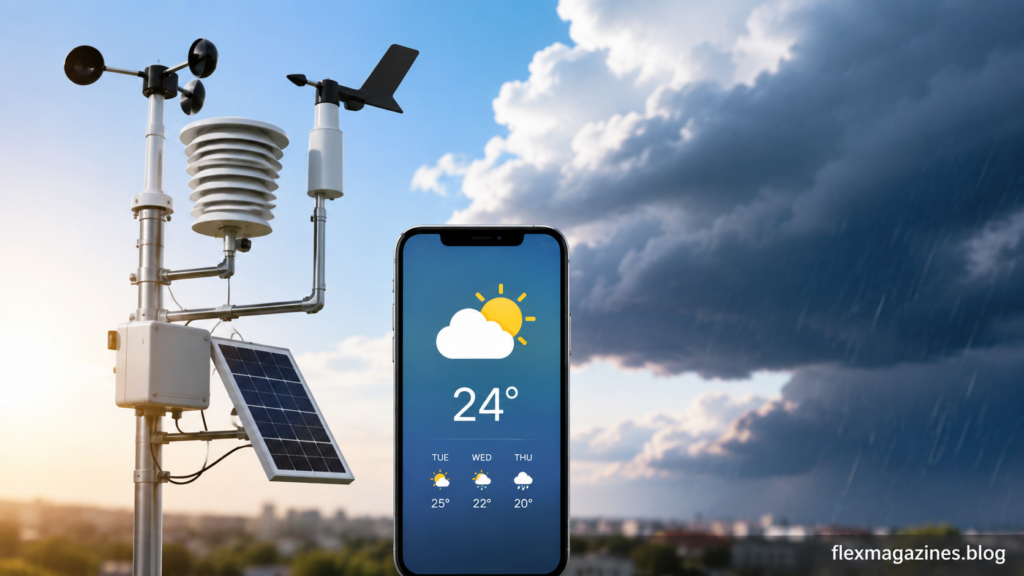

Weather Tech affects almost every part of human life, from daily travel and farming decisions to emergency planning and global business operations. However, predicting weather has always been challenging because the atmosphere is constantly changing.
Weather tech refers to the advanced technologies used to collect, analyze, and predict weather conditions. It combines satellites, radar systems, artificial intelligence, machine learning, sensors, and powerful computing systems to create more accurate weather forecasts.
Modern weather technology goes far beyond simple temperature predictions. Today, weather intelligence platforms help airlines avoid dangerous conditions, farmers improve crop planning, energy companies manage renewable power, and governments prepare for extreme events.
Companies and researchers are increasingly using artificial intelligence to improve forecasting speed and accuracy. AI powered weather models are becoming an important part of the future forecasting ecosystem, working alongside traditional meteorological systems rather than completely replacing them.
What Is Weather Tech?
Weather tech is the combination of science, data, and digital technology used to monitor and predict atmospheric conditions.
Traditional weather forecasting relied heavily on meteorologists analyzing observations from weather stations, satellites, and radar systems. Modern weather technology adds advanced computing, artificial intelligence, and real time data networks.
Weather tech includes
- Weather satellites
- Doppler radar
- Automated weather stations
- Internet of Things (IoT) sensors
- Artificial intelligence forecasting models
- Weather APIs
- Climate risk platforms
- Smart weather devices
The goal of weather technology is simple
Collect better data, analyze it faster, and provide more accurate predictions.
Why Is Weather Technology Important?
Weather is one of the biggest factors influencing human activity.
Accurate weather information helps people make decisions about
- Travel
- Farming
- Construction
- Energy production
- Emergency response
- Business operations
Extreme weather events such as hurricanes, floods, heat waves, and wildfires have increased the need for better forecasting systems.
Modern weather technology helps organizations move from simply reacting to weather problems toward preparing for them in advance.
How Does Weather Tech Work?
Weather technology works through several connected stages.
Data Collection
The first step is gathering information about the atmosphere.
Weather systems collect data from
Satellites
Weather satellites observe
- Cloud movement
- Storm development
- Ocean conditions
- Atmospheric changes
Satellites provide a global view of weather systems.Weather Tech
Weather Radar
Radar technology detects
- Rainfall intensity
- Storm movement
- Wind patterns
- Severe weather development
Doppler radar is especially important for tracking storms because it can measure the movement of precipitation particles.
The National Oceanic and Atmospheric Administration (NOAA) identifies radar, satellites, weather balloons, and automated surface observations as essential tools used by meteorologists.
Ground Sensors
Weather stations collect local information such as
- Temperature
- Humidity
- Wind speed
- Air pressure
- Rainfall
Modern sensor networks allow weather companies to create more localized forecasts.
Artificial Intelligence in Weather Tech
Artificial intelligence is one of the biggest developments in modern weather technology.
Traditional forecasting uses numerical weather prediction models that simulate atmospheric physics using powerful computers.
AI weather models work differently.
They analyze huge amounts of historical weather data and identify patterns that can improve predictions.
AI can help with
- Faster forecasting
- Better pattern recognition
- More localized predictions
- Improved severe weather alerts
Recent AI forecasting systems have demonstrated strong potential, with models such as GraphCast, FourCastNet, and other machine learning systems showing competitive performance against traditional approaches in certain forecasting tasks.
AI Weather Forecasting vs Traditional Forecasting
| Feature | Traditional Forecasting | AI Weather Forecasting |
| Main Technology | Physics based models | Machine learning |
| Data Usage | Observations + simulations | Historical patterns + observations |
| Computing Needs | Very high | Often lower |
| Speed | Slower calculations | Faster predictions |
| Human Role | Meteorologists analyze results | AI assists meteorologists |
AI does not completely replace traditional meteorology. Experts increasingly see the future as a combination of AI systems, scientific models, and human expertise.
Major Types of Weather Tech
Weather Satellites
Satellites are among the most important weather technologies.
They provide information about
- Global cloud systems
- Hurricanes
- Temperature patterns
- Ocean conditions
Without satellites, many large scale weather events would be much harder to monitor.
Smart Weather Stations
Smart weather stations use connected sensors to collect real time information.
They can monitor
- Local temperature
- Rainfall
- Wind
- Soil conditions
These systems are especially useful for
- Agriculture
- Research
- Smart cities
Weather APIs
Weather APIs allow apps and businesses to access weather data.
They power
- Smartphone weather apps
- Travel platforms
- Logistics systems
- Business dashboards
Companies use weather APIs to integrate forecasts into their own products.
Weather Drones
Some companies are developing weather drones to collect atmospheric measurements.
For example, Meteomatics uses weather drone technology alongside high resolution forecasting systems to improve local weather information.
Weather drones can collect data from areas where traditional instruments may be limited.
Leading Weather Tech Companies
The Weather Company
The Weather Company provides weather data, forecasting tools, and decision support technology for consumers and businesses.
Its platforms combine weather information with analytics to help organizations manage weather related risks.
Industries using weather intelligence include
- Aviation
- Transportation
- Energy
- Media
- Government
Tomorrow.io
Tomorrow.io is a weather technology company focused on real time forecasting and weather intelligence.
The company develops weather platforms, APIs, and data solutions designed to improve decision making for businesses and governments.
Meteomatics
Meteomatics develops high resolution weather models, weather data services, and weather drone technology.
Its approach combines atmospheric measurements with advanced forecasting systems.
WindBorne Systems
WindBorne Systems focuses on atmospheric data collection using smart weather balloons.
The company develops systems designed to gather weather information from areas where traditional observations are limited.
How Weather Tech Is Used in Different Industries
Agriculture
Farmers rely on weather technology for
- Crop planning
- Irrigation decisions
- Frost warnings
- Pest management
Accurate forecasts can help reduce waste and improve productivity.
Aviation
Airlines use weather technology to
- Avoid storms
- Improve flight safety
- Optimize routes
- Reduce delays
Weather intelligence helps pilots and aviation companies make safer decisions.
Renewable Energy
Weather data is extremely important for renewable energy.
Solar and wind companies use forecasts to estimate
- Solar production
- Wind availability
- Energy demand
Better predictions help improve energy grid management.
Transportation and Logistics
Companies use weather technology to manage
- Shipping routes
- Delivery schedules
- Road conditions
Severe weather alerts can prevent disruptions.
Disaster Management
Weather technology plays a major role in emergency preparation.
Governments use forecasting systems for
- Hurricane warnings
- Flood preparation
- Wildfire monitoring
- Evacuation planning
Benefits of Weather Tech
More Accurate Forecasts
Better sensors and improved models provide more detailed weather information.
Earlier Warnings
Technology helps identify dangerous weather events earlier.
Better Business Decisions
Companies can reduce weather related losses by planning ahead.
Climate Adaptation
Weather technology helps communities prepare for changing climate conditions.
Challenges of Weather Technology
Despite major improvements, weather forecasting remains difficult.
The atmosphere is extremely complex, and small changes can affect future conditions.
Challenges include
Limited Data Coverage
Some areas, especially oceans and remote regions, have fewer observations.
Extreme Weather Prediction
Predicting exact storm intensity and timing remains challenging.
AI Limitations
AI systems depend on quality data and may struggle with unusual events that are not well represented in historical records.
Experts emphasize that AI forecasting works best when combined with traditional scientific approaches and reliable observations.
The Future of Weather Tech
The future of weather technology will likely include
More Powerful AI Models
AI will continue improving forecast speed and detail.
Hyperlocal Forecasting
Future systems may provide highly specific predictions for neighborhoods, farms, and individual locations.
More Atmospheric Sensors
New satellites, drones, and sensor networks will provide additional weather data.
Climate Intelligence Platforms
Businesses will increasingly use weather technology to manage climate risks.
Conclusion
Weather tech is changing the way the world understands and responds to weather.From satellites and radar systems to artificial intelligence and smart sensors, modern technology is making forecasts faster, more detailed, and more useful.While predicting weather will always involve uncertainty, advances in AI, data collection, and computing are creating a new era of weather intelligence.The future of weather technology will not only focus on predicting tomorrows temperature. It will help people, businesses, and governments make smarter decisions in a world where weather risks are becoming increasingly important.
You may also read more blogs
FAQs
What is weather tech?
Weather tech refers to technologies used to collect weather data, predict conditions, and provide weather intelligence using tools such as satellites, sensors, radar, and AI.
How does AI improve weather forecasting?
AI improves forecasting by analyzing large amounts of weather data, identifying patterns, and producing predictions faster.
What companies use weather technology?
Companies such as The Weather Company, Tomorrow.io, Meteomatics, and WindBorne Systems develop weather technology solutions.
Can weather technology predict storms?
Yes, weather technology helps track and predict storms, although exact intensity and timing can remain difficult because weather systems are complex.
Is AI replacing meteorologists?
No. AI is becoming a powerful tool for meteorologists but works alongside human expertise and traditional forecasting methods.
Why is weather tech important?
Weather technology helps people prepare for dangerous conditions, improve business decisions, and manage climate related risks.
What are examples of weather technology?
Examples include weather satellites, radar systems, smart weather stations, weather apps, AI forecasting models, and weather APIs.