
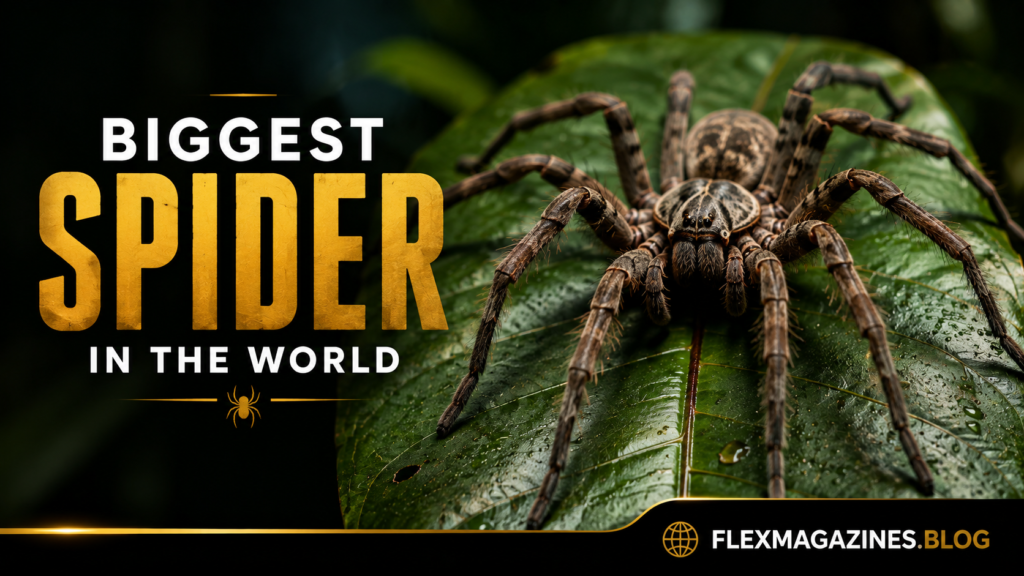

Biggest Spider in the World, When people search for the biggest spider in the world, they often expect a single answer. But spider size can be measured in several ways, making the question more complicated than it initially appears.
The giant huntsman spider (Heteropoda maxima) is generally recognized for having the largest recorded leg span among living spiders, with a documented span of roughly 30 centimeters (about 12 inches). It was discovered in Laos and is famous for its unusually long legs and enormous overall appearance.
However, the giant huntsman is not the heaviest spider.
The Goliath birdeater (Theraphosa blondi), a tarantula native to northern South America, is widely regarded as the heaviest living spider by mass and is also among the largest spiders by body size.
The Biggest Spider by Leg Span
If biggest means widest distance from one leg tip to the opposite leg tip, the giant huntsman is the leading answer.
Its body is not as massive as that of a large tarantula, but its extraordinarily long legs give it an impressive overall span.
This distinction is important because photographs of the giant huntsman can make it look enormous even though much of its measured size comes from its legs rather than its body.
The Biggest Spider by Weight
If the question is instead about body mass, the Goliath birdeater becomes the more appropriate answer.
This giant tarantula has a robust body and thick legs and can reach a substantial weight compared with most other spiders.
Its name is also misleading in an interesting way despite being called a birdeater, birds are not its normal food. Its diet is mainly made up of insects and other small animals.
Latest Facts About the Worlds Largest Spiders
The largest spiders are concentrated in several groups, particularly huntsman spiders and tarantulas.
Their extraordinary sizes are the result of different evolutionary adaptations. Some species have evolved long legs that help them move rapidly across surfaces, while others have developed heavy, powerful bodies suited to life on or beneath the forest floor.
Giant Huntsman Spider
The giant huntsman spider was formally described after specimens were discovered in Laos.
It belongs to the huntsman spider family, known for long legs and a flattened body. Unlike many spiders that sit in webs and wait for prey, huntsman spiders are active hunters.
This lifestyle helps explain their distinctive body shape.
Goliath Birdeater
The Goliath birdeater is native to the rainforests of northern South America.
It is a member of the tarantula family and spends much of its time near the ground, often using burrows or natural shelters.
Its large body and powerful legs make it one of the most impressive arachnids on Earth.
The Giant Huntsman Spider
The giant huntsman spider is one of the most extraordinary spider species ever documented.
Its scientific name, Heteropoda maxima, reflects its position among the largest members of the huntsman family.
Appearance and Physical Features
The giant huntsman has a flattened body and extremely long legs that extend outward from its central body.
This arrangement gives the species a crab like appearance, which is characteristic of huntsman spiders.
Its leg span is responsible for much of its impressive size.
Unlike a tarantula, it doesnt have the thick, heavily built appearance associated with some of the worlds heaviest spiders.
Where Does the Giant Huntsman Live?
The giant huntsman is associated with Laos, particularly limestone cave environments.
Caves and surrounding tropical habitats provide shelter and access to insects and other prey.
Its discovery was particularly notable because large spider species can remain poorly known when they live in difficult to explore environments.
Why Leg Span Matters
A spiders size can be measured in multiple ways.
Scientists and natural history records commonly consider leg span, body length and mass separately because each measurement tells us something different.
Leg Span
Leg span measures the distance across the spiders extended legs.
This is the measurement that gives the giant huntsman its reputation as the largest spider by overall span.
A spider with relatively small body mass can therefore have a larger overall span than a heavier species.
Body Length
Body length focuses on the spiders main body rather than its legs.
This measurement can produce a very different ranking.
Tarantulas generally have much more substantial bodies than huntsman spiders, which is one reason the Goliath birdeater is so impressive even though the giant huntsman can have a greater leg span.
The Goliath Birdeater
The Goliath birdeater is arguably the worlds most famous giant spider.
Its enormous body, thick legs and defensive hairs make it one of the most visually intimidating members of the tarantula family.
Where the Goliath Birdeater Lives
The species is native to tropical South America, including areas of Guyana, Suriname, French Guiana, Venezuela and Brazil.
Its rainforest habitat provides plenty of insects and other small animals.
The humid environment is also well suited to a large terrestrial tarantula.
Why Is It Called a Birdeater?
The name comes partly from historical reports and illustrations suggesting that large tarantulas could prey on birds.
However, birds are not the species normal food source.
Goliath birdeaters primarily consume insects and other invertebrates, although their size means they are capable of tackling a variety of relatively large prey.
Why Body Mass Changes the Answer
The biggest spider by span isnt necessarily the biggest spider by weight.
This is one of the most important facts to understand when researching the biggest spider in the world.
Huntsman Versus Tarantula
The giant huntsman has long, slender legs and a relatively flattened body.
The Goliath birdeater has a much more substantial body and heavier legs.
As a result, the two spiders excel in different categories.
Which One Looks Bigger?
Visual perception can be misleading.
A huntsman spider can appear enormous because its legs spread across a large area. A Goliath birdeater can look more compact but has far greater bulk.
If you place the two side by side, the difference in body structure becomes immediately apparent.
Biggest Spider by Leg Span vs. Weight
The simplest way to answer the question is to separate the categories.
Largest recorded leg span Giant huntsman spider (Heteropoda maxima)
Heaviest living spider Goliath birdeater (Theraphosa blondi)
Largest tarantula by overall appearance Goliath birdeater is one of the strongest contenders.
This means that a headline saying the worlds biggest spider can be technically incomplete unless it explains how size is being measured.
Why There Isnt One Universal Winner
Spider anatomy makes a single ranking difficult.
A spider can have an enormous leg span without having a particularly heavy body.
Another species may have a shorter span but substantially greater mass.
Thats why scientific comparisons should identify the measurement being used.
Where the Worlds Biggest Spiders Live
Large spiders are particularly associated with tropical and subtropical environments.
Warm temperatures, abundant prey and suitable shelter can support larger bodied arachnids.
South American Rainforests
South Americas tropical forests are home to numerous giant tarantula species.
The Goliath birdeater thrives in humid forest habitats where it can find insects and other prey.
The regions rich biodiversity creates an ideal environment for large terrestrial spiders.
Southeast Asian Caves and Forests
The giant huntsman represents another evolutionary route toward extreme spider size.
Its association with caves in Laos makes it particularly fascinating because cave ecosystems can support specialized animals that are rarely encountered by humans.
The discovery of a spider of such extraordinary size in this environment demonstrated that even relatively large animals can remain poorly documented.
What Makes These Spiders So Large?
Spider size is influenced by evolution, habitat, food availability and physical limitations.
Unlike mammals, spiders have an exoskeleton, meaning their skeleton is on the outside of the body.
The Role of the Exoskeleton
Spiders periodically molt as they grow.
A spider must shed its old exoskeleton and form a larger one.
This process becomes increasingly challenging as body size increases.
Oxygen and Body Size
Spiders also have respiratory systems that impose physiological constraints.
Large spiders therefore cannot simply continue growing indefinitely.
Their size reflects a balance between evolutionary advantages and biological limitations.
How Giant Spiders Hunt
Not every giant spider builds a traditional web to capture prey.
Some of the worlds largest spiders are active hunters.
Huntsman Hunting Strategy
Huntsman spiders use speed and mobility to chase prey.
Their long legs allow them to move rapidly across surfaces, and their flattened bodies can help them navigate narrow spaces.
They generally dont depend on large prey catching webs in the same way as orb weaving spiders.
Goliath Birdeater Hunting
The Goliath birdeater uses a different strategy.
It is a terrestrial tarantula that can wait near a burrow or shelter and ambush prey.
Its powerful fangs and large body allow it to overpower animals that would be impossible for smaller spiders to handle.
What Do the Biggest Spiders Eat?
The diets of giant spiders are surprisingly diverse.
Despite the terrifying reputation of some species, insects and other invertebrates make up a significant portion of their diet.
Insects and Other Invertebrates
Large tarantulas can consume crickets, cockroaches, beetles and other insects.
They may also take advantage of other available prey when opportunities arise.
Their size allows them to tackle food items that smaller spiders could not subdue.
Small Vertebrates
Some large spiders are capable of eating small vertebrates such as frogs, lizards and rodents.
These events are less common than typical insect predation.
The famous birdeater name exaggerates the importance of birds in the Goliath birdeaters diet.
Are the Biggest Spiders Dangerous?
The worlds largest spiders can certainly bite, but their frightening appearance does not mean they are actively seeking humans.
Most large spiders prefer to avoid people.
Goliath Birdeater Defense
When threatened, the Goliath birdeater can use defensive behaviors including urticating hairs.
These tiny hairs can irritate skin and mucous membranes.
The species can also use its fangs defensively if seriously threatened.
Giant Huntsman Behavior
The giant huntsman is also not known for hunting humans.
Like other huntsman spiders, it is generally interested in finding prey and avoiding danger rather than confronting people.
A bite can be painful, but the species is not generally regarded as a major medical threat to humans.
Biggest Spider Species Compared
Several spiders deserve attention when discussing the worlds largest arachnids.
Giant Huntsman
The giant huntsman is famous for its exceptional leg span.
Its long legged, flattened design gives it a distinctive appearance and helps it move through its environment.
It is the key species to remember when the question focuses specifically on largest leg span.
Goliath Birdeater
The Goliath birdeater stands out for its massive body and overall weight.
It is one of the most famous tarantulas in the world and can reach an extraordinary size compared with most spiders.
Other Giant Tarantulas
Several other tarantula species are also enormous.
Species within genera such as Theraphosa and Lasiodora can reach impressive sizes and are frequently included in discussions about the largest spiders.
However, individual specimens vary, and record claims should always specify how the spider was measured.
How Researchers Measure Spider Size
Measuring a spider isnt as simple as placing a ruler next to it.
Researchers must decide which anatomical dimension they are recording.
Measuring Leg Span
Leg span is typically measured from one extended leg to another.
Because spiders can change their posture, measurements need to be interpreted carefully.
This is one reason record sized specimens attract attention an unusually large measurement can become a widely repeated statistic.
Measuring Body Size
Body length is measured independently of the legs.
Mass can also be recorded using a scale.
For scientific comparisons, all three measurements can be valuable because they provide a more complete picture of the animal.
Giant Spiders and Common Myths
Giant spiders are surrounded by myths.
Some are based on real observations, while others have been exaggerated through movies, viral social media posts and sensational headlines.
Do Giant Spiders Really Eat Birds?
The answer is more nuanced than the name suggests.
The Goliath birdeater is capable of eating vertebrate prey, but birds arent its normal diet.
The majority of its prey consists of insects and other accessible animals.
Are Giant Spiders as Large as They Look in Photos?
Photography can exaggerate scale.
A spider positioned close to the camera can appear dramatically larger than it really is.
For accurate comparisons, researchers use measurements rather than photographs alone.
Why Is the Biggest Spider Trending?
Searches for the biggest spider in the world frequently increase when photographs or videos of unusually large spiders go viral.
Social media has made giant spider discoveries particularly shareable because their appearance generates immediate curiosity.
Viral Spider Videos
A large spider walking across a wall or appearing beside a persons hand can quickly attract millions of views.
But online images can lack scale references or use camera angles that exaggerate size.
Thats why scientific measurements are more reliable than viral visual comparisons.
Why People Are Fascinated by Giant Spiders
Spiders occupy an unusual place in human culture.
They can inspire fear and fascination simultaneously.
The worlds largest species intensify that reaction because they challenge our expectations about how large a spider can become.
Conclusion
The answer to biggest spider in the world depends on what you mean by biggest.If youre talking about maximum recorded leg span, the giant huntsman spider (Heteropoda maxima) is the standout species, with a recorded span of roughly 30 centimeters. If youre talking about weight and body mass, the Goliath birdeater (Theraphosa blondi) takes the spotlight as one of the heaviest living spiders.Both species demonstrate just how diverse spiders can be. The giant huntsmans long legs are adapted for active hunting and movement, while the Goliath birdeaters heavy body and powerful build make it an extraordinary rainforest predator.Despite their intimidating appearance, these spiders generally have little interest in humans. They play important roles as predators in their ecosystems, helping regulate populations of insects and other small animals.
You may also read more blogs
FAQs
What is the biggest spider in the world?
The giant huntsman spider (Heteropoda maxima) is generally recognized as the spider with the largest recorded leg span, reaching roughly 30 centimeters. The Goliath birdeater is generally considered the heaviest living spider.
What is the largest spider by weight?
The Goliath birdeater (Theraphosa blondi) is widely regarded as the heaviest living spider. Its large, robust body gives it considerably more mass than many long legged spider species.
Is the Goliath birdeater the biggest spider?
It depends on how biggest is defined. The Goliath birdeater is one of the largest and heaviest spiders, while the giant huntsman holds the distinction for the largest recorded leg span.
Where does the biggest spider in the world live?
The giant huntsman is associated with Laos in Southeast Asia, while the Goliath birdeater is native to tropical parts of northern South America.
Can the worlds biggest spider hurt humans?
Large spiders can bite when threatened, but they generally avoid humans. The Goliath birdeater can deliver a painful bite and has irritating defensive hairs, while the giant huntsman is not generally considered a major threat to people.
Do giant spiders eat humans?
No. Humans are far too large to be normal prey for spiders. Even the worlds largest spiders primarily consume insects, other invertebrates and, occasionally, small vertebrates.
Do Goliath birdeaters really eat birds?
Birds are not their normal food. The name comes from historical observations and the species ability to prey on relatively large animals, but insects and other small animals make up much more typical prey.
Why are some spiders so large?
Large spider species have evolved in environments where their size can provide advantages for hunting and survival. Their maximum size is also limited by factors such as their exoskeleton, molting process and respiratory physiology.